
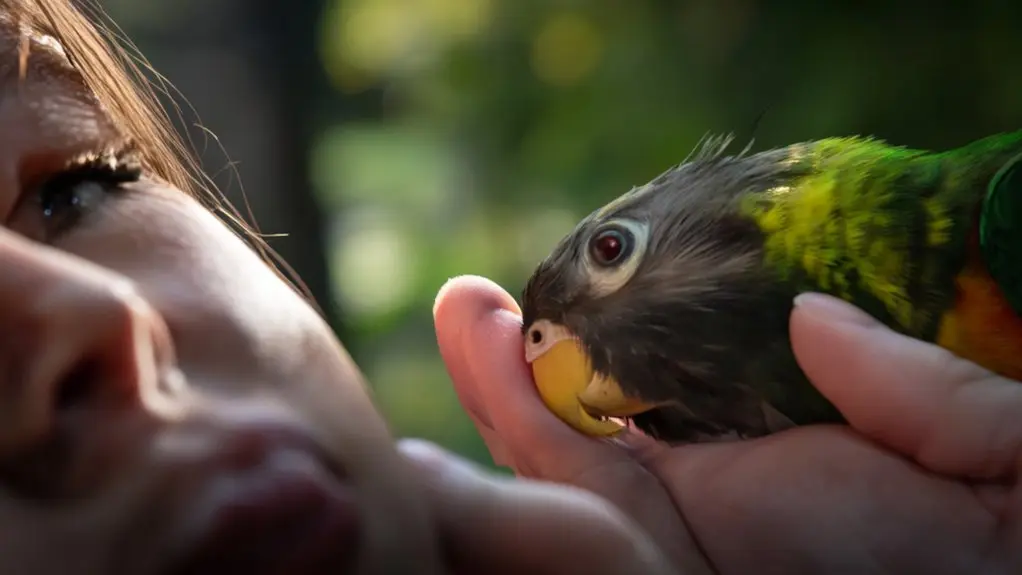
You can form strong bonds with pet birds, as they recognize and respond to you through behaviors like preening, vocalizing, and seeking proximity. However, their feelings differ from human love. They’re rooted more in social recognition, trust, and instinctual drives rather than romantic emotions.
Birds’ attachments prioritize social bonding for survival and emotional stability, not human concepts of love. It’s pretty fascinating how their behavior shows complex social cognition and emotional connections beyond simple affection.
So, while it might not be love like we think of it, the bond you share with a bird is still meaningful and important. It’s all about understanding their unique way of connecting.
Do Birds Really “Love” Humans?
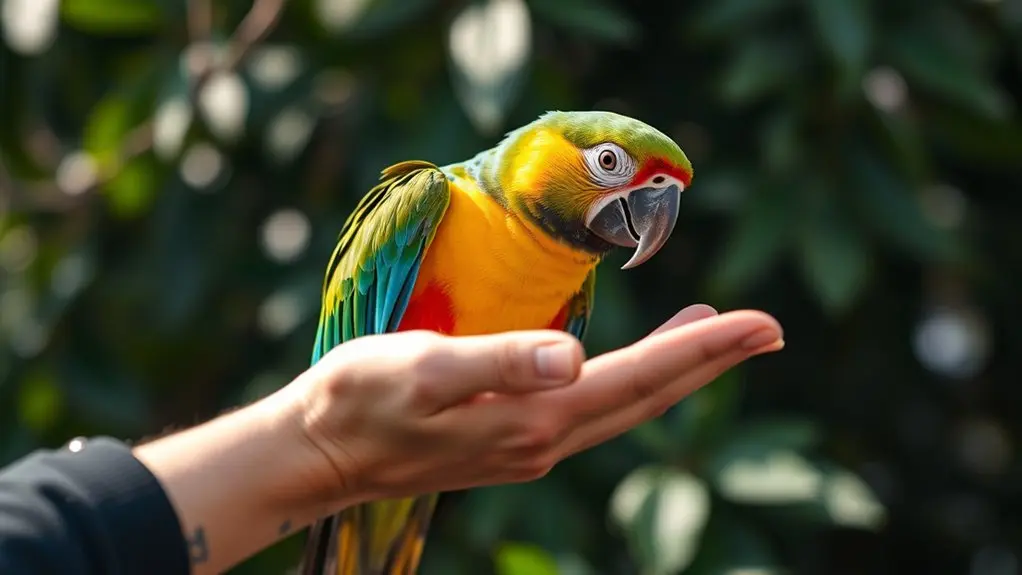
How do birds express their bonds with humans, and can these behaviors be equated with love? You observe birds displaying attachment-like behaviors such as following, preening, and vocalizing toward humans.
Scientific studies reveal that species like parrots and corvids show trust and recognition, which resemble social bonds.
However, birds’ behaviors stem from biological instincts linked to survival, similar to those driving bird migration or nest building. These activities are essential for reproduction and safety, not emotional connections comparable to human love.
While birds develop preferences and loyalty toward humans, their responses are better understood as adaptive social behaviors rather than genuine emotional love.
How Birds Show Affection and Form Bonds
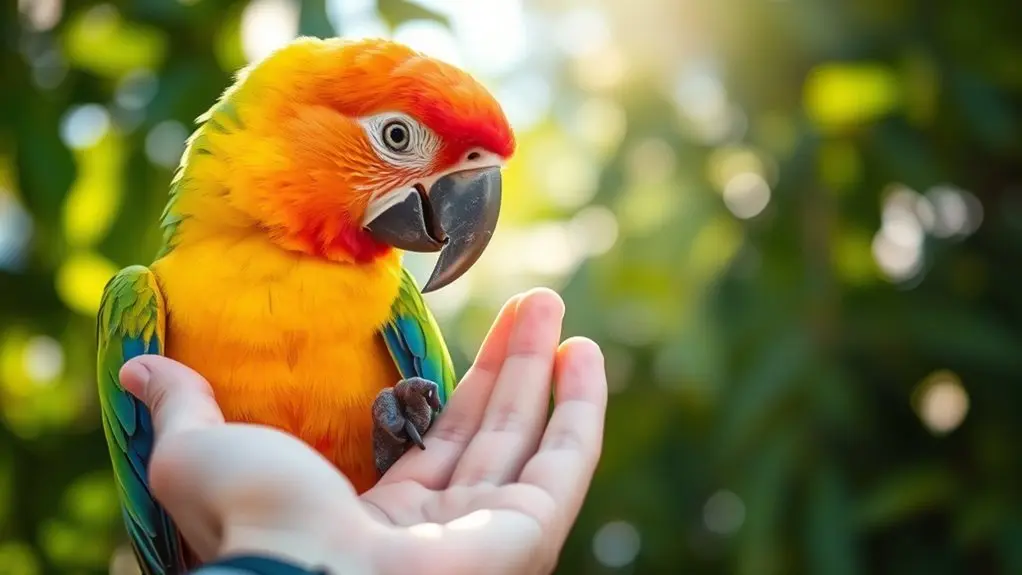
You can actually see birds showing affection in a few sweet ways, like preening you, nuzzling up close, or making soft little sounds just for you.
Parrots and cockatoos, for example, often form really strong bonds—they might choose to sit right on your shoulder or follow you around like a little shadow.
When these behaviors happen again and again, especially after positive interactions, it shows that birds are capable of emotional bonding and trust.
It’s pretty amazing how connected they can become!
Affectionate Bird Behaviors
Although birds can’t express affection through words, they show strong social bonds with humans through distinct behaviors. You’ll notice feather grooming when a bird preens you, which is similar to how they maintain bonds in the wild.
Vocal mimicry is another key sign, as birds imitate your speech or sounds to show recognition and social connection.
Their body language and interactions also reveal affection. For example, you might see them preening or nuzzling against you as a grooming gesture. They often call out or seek your attention frequently.
You might notice tail wagging, hopping, or singing when they’re excited. Birds also tend to stay close to you for long periods.
Mimicking your vocal patterns is another way they bond socially.
All these behaviors scientifically indicate trust and attachment, even without verbal communication. It’s their way of saying they care.
Bonding Mechanisms in Birds
Building on the affectionate behaviors birds display, their bonding mechanisms involve a combination of physical, vocal, and hormonal interactions that reinforce social connections. You’ll notice birds engage in preening and grooming to strengthen bonds, often paired with mutual vocalizations and synchronized activities like feeding or climbing together.
These behaviors, linked to nesting behaviors, signal strong attachments, similar to pair-bonded birds showing increased parental care.
Hormonal shifts, especially elevated oxytocin during close contact, biologically support these bonds. Additionally, birds’ migration patterns often coincide with social groupings, reinforcing familiarity and attachment through repeated interactions.
You can observe that birds preferentially recognize and interact with specific individuals, including humans, indicating a complex bonding system grounded in both behavioral and physiological processes.
Can Birds Recognize and Respond to Their Owners?
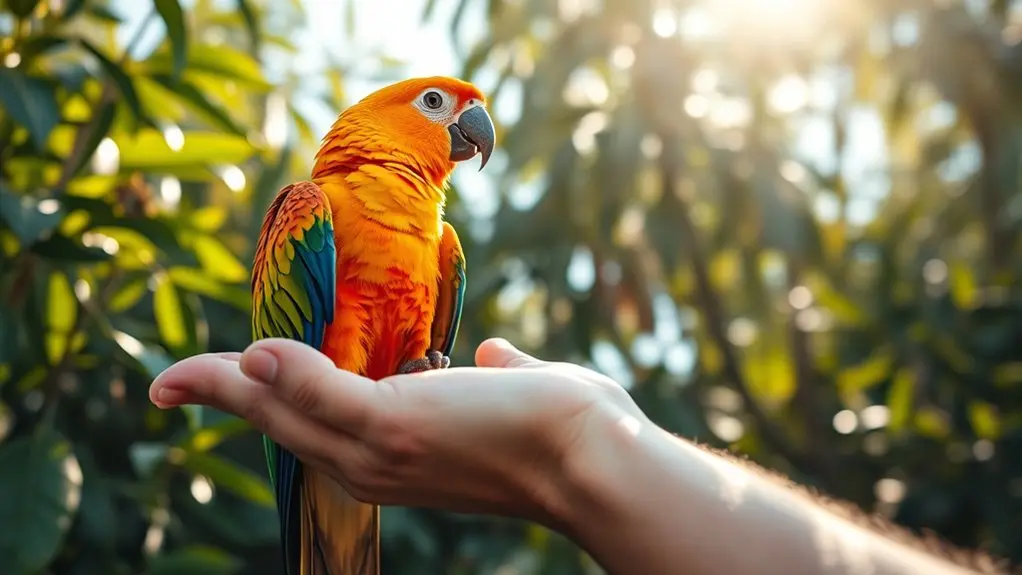
You can see that many birds, like parrots and corvids, actually recognize and remember their owners by using both visual and auditory cues. It’s pretty fascinating!
They often respond to familiar humans with behaviors like vocalizing, preening, or even following them around closely. These actions really show the strong emotional bonds birds can form, as well as their impressive cognitive abilities when it comes to their human caregivers.
Owner Recognition Abilities
When birds like parrots and crows interact with humans regularly, they develop the ability to recognize individual owners based on visual and auditory cues. This capacity highlights advanced bird cognition and social recognition skills.
Research shows that birds differentiate familiar owners from strangers by processing distinct facial features and voice patterns.
Their memory of specific human interactions further supports these cognitive abilities. You can often observe this recognition through behaviors like vocalizations or attentive postures.
Key points about owner recognition abilities include:
- Recognition relies on visual and auditory stimuli.
- Birds distinguish individual human faces.
- Vocal cues play a significant role in identification.
- Memory retention of owners lasts over time.
- Recognition indicates complex social cognition in birds.
These findings confirm that birds possess sophisticated recognition skills essential for forming social bonds with humans. It’s pretty amazing how smart and socially aware they are!
Behavioral Responses To Owners
Although birds rely on various sensory cues to recognize individuals, their behavioral responses provide clear evidence that they not only identify their owners but also adjust their interactions accordingly.
You’ll notice birds engaging in feather grooming more frequently when near familiar humans, a behavior indicating comfort and trust.
Additionally, vocal mimicry serves as a communicative tool. Birds often replicate their owner’s sounds or calls, reinforcing recognition and social connection.
Studies reveal parrots and corvids remember specific human faces and voices, responding with increased vocalizations and proximity to their owners.
These behaviors demonstrate not only recognition but also selective social engagement, distinguishing owners from strangers.
By observing these precise behavioral responses, you can objectively confirm that birds adjust their interactions based on familiarity.
It really highlights their capacity to recognize and respond meaningfully to individual humans.
Emotional Bonds With Humans
Since birds possess the ability to recognize and remember individual humans, they often form emotional bonds with their owners that go beyond mere familiarity. You’ll notice that birds like parrots and corvids use bird communication, such as vocalizations and gestures, to interact specifically with those they trust.
Their feather grooming behaviors, like preening, often extend toward their owners, showing attachment.
Research shows these birds differentiate familiar humans from strangers. They respond with more affiliative behaviors toward their owners.
You can expect birds to seek proximity and display signs of comfort when bonded.
- Individual recognition of owners
- Use of vocalizations in bird communication
- Feather grooming directed at humans
- Preference for familiar over unfamiliar people
- Attachment behaviors like following owners
These findings suggest birds’ emotional capacities are more complex than once assumed. It’s pretty amazing how much they can connect with us!
Why Birds’ Attachments Differ From Human Love
Because birds rely heavily on consistent positive interactions and social bonds, their attachments differ fundamentally from the emotional complexity of human love. You’ll notice birds prioritize reproductive success and social stability, driven by biological cues rather than emotional affection.
For example, bird migration and nest building serve survival and reproductive functions, not emotional bonding. Their pair bonds focus on mutual cooperation, which is essential for offspring survival.
| Aspect | Birds’ Attachment Focus | Human Love Focus |
|---|---|---|
| Basis | Biological, behavioral cues | Emotional, psychological |
| Purpose | Reproduction, social stability | Emotional fulfillment |
| Duration | Seasonal or reproductive cycles | Lifelong, complex bonds |
Understanding these distinctions helps clarify why birds’ attachments aren’t equivalent to human love. It’s pretty interesting when you think about it!
What People Get Wrong About Bird “Love
Understanding the biological basis of birds’ attachments helps clarify common misconceptions about their behavior. When you observe a bird preening you or following your movements, it’s easy to interpret this as love. However, these actions primarily reflect social bonding or comfort, not romantic emotions.
Bird migration and nest building are instinct-driven activities focused on survival and reproduction, not emotional attachment. Birds recognize caregivers through learned familiarity, not affection.
Here’s what you often get wrong about bird “love”:
- Birds’ affectionate behaviors serve reproductive or social purposes, not emotional love.
- Pair bonds result from biological imperatives, not human-like emotions.
- Birds use nest building and guarding to ensure reproductive success.
- Attachment to humans is based on trust, not romantic feelings.
- Bird migration patterns emphasize survival, unrelated to emotional bonds.
The Science Behind Bird Attachment and Emotions
Although birds don’t experience emotions exactly as humans do, scientific research shows that many species form attachments through consistent social interactions and recognition.
Birds like parrots and crows often show affectionate behaviors, such as seeking contact or vocalizing when they reunite with their human caregivers.
Parrots and crows often display affection by seeking contact and vocalizing upon reunion with humans.
Studies on zebra finches reveal that mutual choice and bonding harmony improve parental care and reproductive success, which suggests some level of emotional investment.
Birds also get stressed when separated from preferred mates or humans, which is another sign of attachment.
Interestingly, bird migration and feather coloration play important roles in social signaling and mate selection.
This supports the idea that birds have complex emotional communication.
Behaviors like leaning into handlers or preening can be seen as signs of attachment, rooted more in evolutionary biology than human-like love.
How to Strengthen Your Bond With a Pet Bird
When you consistently spend quality time interacting gently with your pet bird and use positive reinforcement, you create a foundation of trust essential for strengthening your bond. Recognizing and responding to your bird’s behavior scientifically improves attachment.
Focus on understanding its flight patterns to anticipate its movements and reduce stress. Feather grooming sessions are key for mutual comfort and trust building.
- Engage in gentle feather grooming to promote relaxation and familiarity
- Observe and respect your bird’s flight patterns to ensure safe interaction
- Use treats and positive reinforcement during training and play
- Maintain a calm, patient demeanor to avoid causing anxiety
- Provide toys and an enriched environment that simulates natural behaviors
These methods foster a healthy, trusting relationship between you and your pet bird.
Frequently Asked Questions
Can Birds Survive Without Human Interaction?
You’ll find that birds, guided by avian communication cues and innate bird migration patterns, can survive without human interaction. They rely on their natural behaviors and environmental adaptations to thrive independently in the wild.
Basically, birds know what to do to get by without us. They have their own ways of communicating and navigating that help them stay safe and find food. So, even if humans aren’t around, birds are pretty good at taking care of themselves.
Do Wild Birds Show Affection to Humans?
You’ll observe that wild birds often show bird bonding through repeated human interaction. They recognize individuals and respond with behaviors like food sharing or vocalizing. This indicates attachment but not necessarily affection as humans define it.
What Bird Species Are Most Social With Humans?
Like magnets drawn together, parrots, cockatoos, and lovebirds exhibit strong bird bonding influenced by human interaction. Their social nature thrives on human influence, making them the most interactive species forming affectionate, lasting connections with you.
They really love being around people and often seek out attention and companionship. It’s like they genuinely enjoy hanging out with you, not just being pets. This makes them incredibly rewarding to have around.
How Long Do Birds Typically Live as Pets?
You’ll find bird lifespan varies widely; smaller species live 5–10 years, while large parrots can reach 40–60 years or more.
Consistent pet bird care, including diet and vet visits, directly impacts their longevity and health.
Taking good care of your feathered friend really makes a difference!
Are There Signs of Stress When Birds Dislike Humans?
You’ll notice bird signaling through stress behaviors like feather plucking or pacing. Stressed birds can show up to 50% higher corticosterone levels.
These clear signs indicate discomfort and dislike toward human interaction. They help you assess their well-being.
Conclusion
Understanding bird affection is like decoding a complex language of feathers and sounds. While birds don’t love like humans, they form genuine bonds through recognition and interaction. Their attachment reflects survival instincts and social behavior rather than romantic emotion.
By observing their cues and responding thoughtfully, you can nurture a meaningful connection. Remember, bird “love” is a unique dance of biology and behavior. So, appreciate it on its own fascinating terms.