
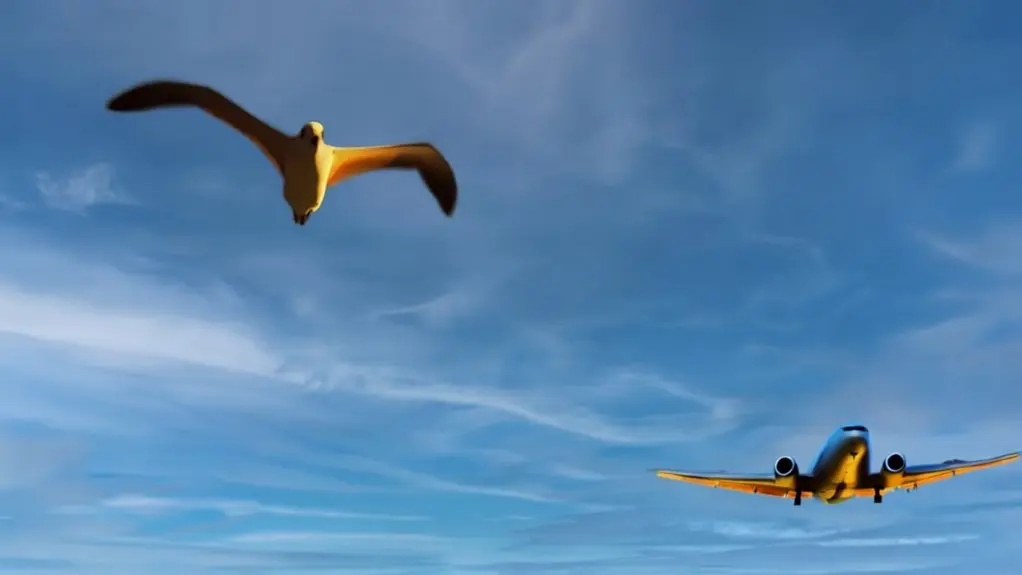
You won’t see birds outpace airplanes in level flight since planes cruise between 900 km/h and supersonic speeds, while most birds top out around 110 km/h.
However, certain species like peregrine falcons can exceed 320 km/h during steep dives by folding their wings and streamlining their bodies. They exploit gravity and aerodynamics to reach these impressive speeds.
Bird size, wing shape, and wind conditions also affect speed. But biological energy limits prevent sustained airplane-level velocities.
Exploring these factors reveals some pretty intriguing flight dynamics.
How Fast Can Birds Fly Compared to Airplanes?
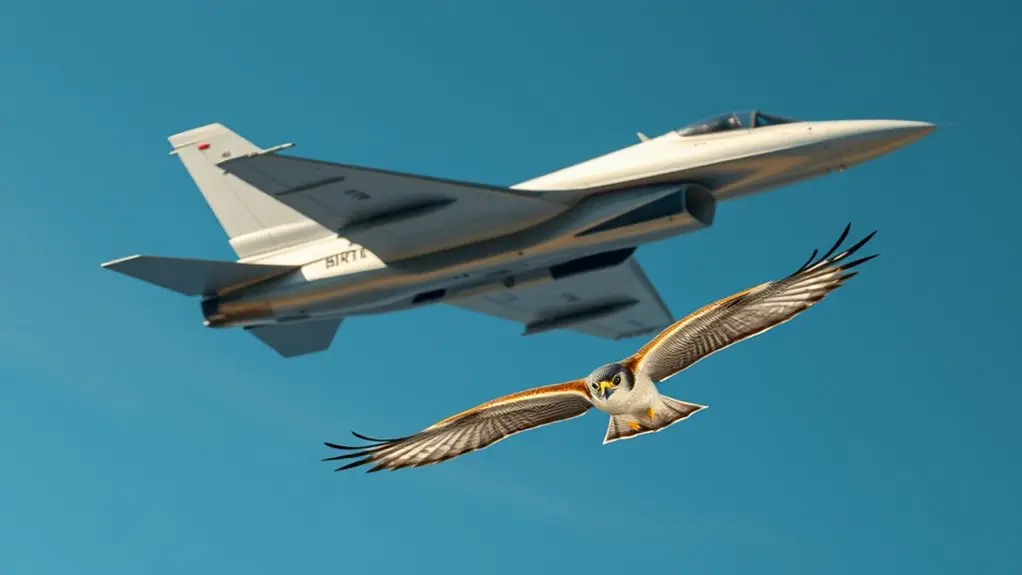
Although some birds can reach remarkable speeds in flight, their typical velocities usually don’t match those of airplanes. You’ll find species like the peregrine falcon diving at over 320 km/h, but during level flight, most birds cruise between 57 and 111.5 km/h.
While some birds dive at over 320 km/h, their regular flight speeds are much slower than airplanes.
The common swift holds the record for level flight speed at about 111.5 km/h, still slower than many small aircraft.
Notably, feather coloration and nesting habits influence flight efficiency. Vibrant feathers can affect aerodynamics, while nesting in high, open areas often correlates with species adapted to faster flight.
Despite occasional unconfirmed reports of speeds over 169 km/h in birds like the white-throated needletail, modern airplanes generally maintain superior cruising speeds.
This just shows how bird flight strategies differ fundamentally from mechanical aviation. So, while birds are impressive flyers, airplanes still have them beat when it comes to speed.
Why Do Birds Fly Faster When Diving Than Level Flying?
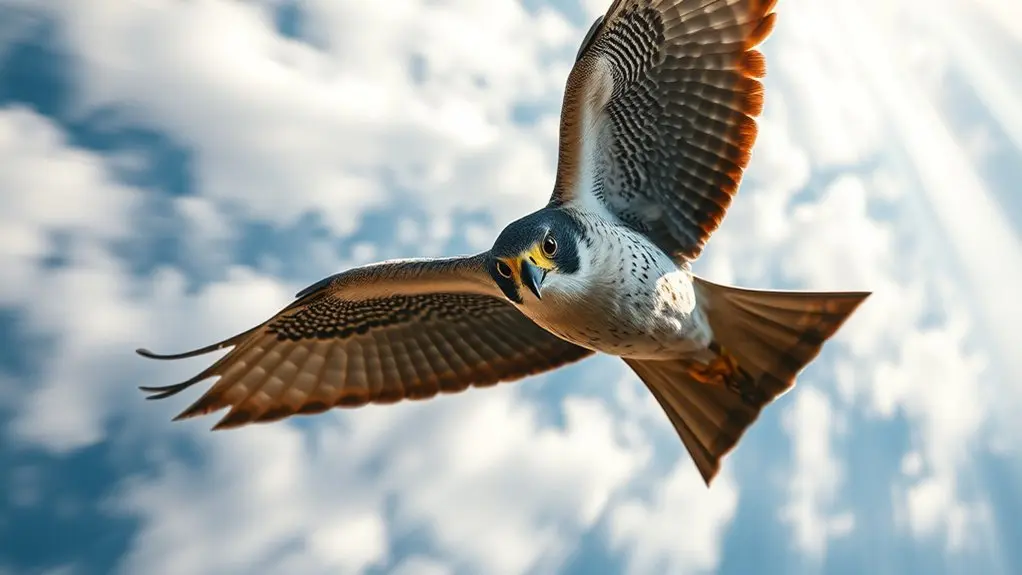
When birds dive, they tap into gravity’s force to accelerate far beyond their typical level flight speeds. Unlike level flying, where wing flapping and gliding propel them, dives use streamlined wing folding that minimizes drag. This aerodynamic posture, combined with gravity, lets birds maximize speed while keeping control by managing airflow over their bodies.
Feather durability plays a big role here. Strong feathers can handle the increased aerodynamic stress without getting damaged. It’s pretty amazing how the precision needed for dives is similar to the delicate coordination birds use when building nests. This shows just how much control birds have over their bodies.
| Aspect | Effect on Dive Speed |
|---|---|
| Gravity | Provides acceleration |
| Wing Folding | Reduces drag |
| Aerodynamic Shape | Enhances lift and control |
| Feather Durability | Prevents feather damage |
| Body Control (Nest Building Skills) | Ensures precision and stability |
What Makes Peregrine Falcons the Fastest Dive Flyers?
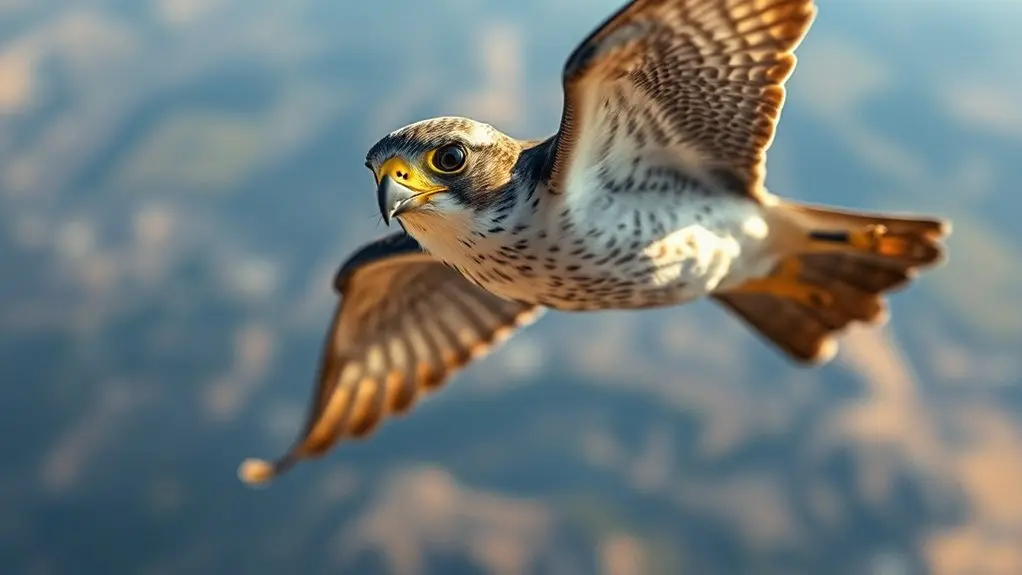
You’ll notice peregrine falcons reach incredible speeds by folding their wings tightly against their bodies, which drastically reduces drag. This sleek, aerodynamic shape lets air flow smoothly around them.
Because of that, gravity and their powerful muscles can accelerate them really quickly.
Getting how they position their wings and shape their bodies is key to understanding why they’re the fastest flyers when they dive at high speeds.
Dive Aerodynamics Explained
Because peregrine falcons combine gravity-assisted acceleration with specialized aerodynamic features, they achieve dive speeds exceeding 320 km/h (200 mph). This makes them the fastest dive flyers in the avian world.
You’ll notice their streamlined head and pointed wings, which reduce drag considerably during dives.
Their powerful chest muscles swiftly fold their wings close to their bodies, minimizing air resistance and shaping them like sleek missiles.
Fascinatingly, their feather coloration isn’t just for camouflage. It also contributes to aerodynamic efficiency by smoothing airflow.
Nesting behavior influences their dive aerodynamics too. Falcons often nest on high cliffs, providing ideal launch points that maximize gravitational acceleration.
Together, these anatomical and behavioral adaptations enable peregrine falcons to master dive aerodynamics, reaching breathtaking speeds unmatched by any other bird.
Wing Positioning And Speed
The peregrine falcon’s ability to reach extraordinary speeds hinges on its precise wing positioning during high-velocity descents. You’ll notice the falcon folds its wings tightly against its body, reducing drag by minimizing surface area.
This streamlined posture, aided by feather flexibility, allows it to cut through air with minimal resistance.
During a dive, the falcon tilts its wings downward and tucks them close, creating an aerodynamic profile that maximizes acceleration. Its wing muscles and skeletal adaptations enable rapid folding and unfolding, so it can adjust speed and trajectory instantly.
Remarkably, its beak shape also contributes by reducing air resistance around the head, complementing the aerodynamic wing position.
This combination lets the peregrine falcon achieve dive speeds over 320 km/h, making it the fastest dive flyer in the bird world.
How Do Bird Size and Shape Affect Flight Speed?
You’ll notice that a bird’s wing shape directly impacts its flight speed because it changes how lift and drag work.
Plus, body mass plays a big role—heavier birds often prefer gliding instead of flapping fast to save energy.
On top of that, aerodynamic features like pointed wings and streamlined bodies help reduce air resistance, letting some species reach impressive speeds.
Wing Shape Impact
Although bird size and shape vary widely, their wing design plays a crucial role in determining flight speed. Birds with long, narrow wings, like falcons and swifts, reduce drag and optimize airflow. This allows for faster, sustained flight.
In contrast, larger birds such as albatrosses have broad wings suited for soaring but achieve lower maximum speeds. Wing shape also influences flight style. Pointed wings promote velocity, while rounded wings enhance maneuverability.
This often aligns with specific nesting behavior and habitat demands. Interestingly, feather coloration can be linked to wing structure, affecting thermoregulation and flight efficiency indirectly.
When you observe birds, their wing aspect ratio—long and slender versus broad—directly impacts lift and drag forces. This consequently shapes their flight speed capabilities within ecological and behavioral contexts.
Body Mass Influence
When you consider how bird size and shape influence flight speed, body mass emerges as a key factor affecting aerodynamic performance. Larger birds like albatrosses and swans possess greater body mass, which increases drag and lowers their maximum level flight speeds despite efficient soaring capabilities.
In contrast, smaller birds such as swifts have lightweight bodies that reduce energy expenditure and enable rapid wing beats, achieving higher relative speeds.
While body mass is vital, it interacts with other traits like feather coloration, which can affect thermoregulation, and nesting behaviors that influence muscle development and energy allocation for flight.
Understanding these relationships helps explain why smaller, agile birds often outpace heavier species. So, body mass combined with ecological and physiological factors shapes flight speed more intricately than size alone.
Aerodynamic Adaptations
Since wing shape directly influences aerodynamic forces, understanding how size and form affect flight speed is essential. Larger birds like albatrosses feature long, narrow wings with high aspect ratios. This design optimizes gliding efficiency but doesn’t necessarily maximize speed.
Smaller birds with pointed wings, such as swifts and falcons, reduce drag. This lets them accelerate quickly and reach higher top speeds.
Feather coloration sometimes plays a subtle role in thermoregulation, which indirectly supports flight endurance.
Nesting behaviors also influence the evolution of wing morphology. Species that need agile maneuvering in dense habitats often have rounded wings for better control instead of speed.
Your observation of these aerodynamic adaptations shows how wing curvature, size, and body mass work together. They balance lift, drag, and velocity to fit each bird’s ecological niche.
How Do Wind and Weather Influence Bird Flight Speeds?
Because wind plays a crucial role in bird flight, you’ll notice that a strong tailwind can dramatically increase a bird’s groundspeed beyond its typical airspeed. Birds exploit wind patterns and weather conditions by adjusting flight altitude and timing. For example, migrating birds often ascend to altitudes with favorable jet streams, boosting speeds over 100 km/h.
Conversely, storms and gusty winds can slow or disrupt flight depending on their direction and intensity. These factors cause variations between airspeed (relative to the air) and groundspeed (relative to the ground). You can observe these effects in the table below:
| Wind Pattern | Weather Condition | Effect on Flight Speed |
|---|---|---|
| Tailwind | Clear skies | Increases groundspeed |
| Headwind | Stormy | Decreases groundspeed |
| Crosswind | Gusty | Causes flight adjustments |
| Jet stream | Stable | Enables high-speed travel |
How Do Scientists Measure Bird Flight Speeds Accurately?
You use Doppler radar and GPS tracking to get precise data on how fast birds are moving over the ground. At the same time, anemometers help measure wind conditions so you can adjust those readings and figure out the bird’s true airspeed.
High-speed cameras and wind tunnels come into play as well, giving insights into the mechanics of bird flight. But it’s not always straightforward—environmental changes and the limits of measurement tools can make accuracy a bit tricky.
Techniques For Speed Measurement
How exactly do scientists measure bird flight speeds with precision? They combine advanced tools like Doppler radar, high-speed cameras, and wind tunnels to analyze bird feathering and flight thermals. Doppler radar tracks ground speed relative to moving air masses, while high-speed cameras capture wing motion at thousands of frames per second.
Wind tunnels simulate aerodynamic forces on feathers under controlled conditions. GPS and geolocators add data on altitude and migration routes, refining speed estimates. Researchers also measure environmental factors like wind speed separately to calculate true airspeed accurately.
| Technique | Purpose | Key Insight |
|---|---|---|
| Doppler Radar | Track ground speed | Relative to air movement |
| High-Speed Cameras | Capture wing motion | Analyze feathering details |
| Wind Tunnel | Simulate flight conditions | Study aerodynamic forces |
Challenges In Accurate Tracking
While advanced techniques like Doppler radar and high-speed cameras provide valuable data on bird flight speeds, accurately tracking these speeds presents several challenges. When studying bird migration, you have to consider factors that complicate measurements.
For example, variability in flight behavior and body position affects speed readings, so it requires careful calibration. Also, differentiating groundspeed from airspeed means you need to account for wind effects, which can skew data if ignored.
Plus, feather coloration and patterns influence how radar signals reflect, which impacts the precision of radar-based tracking.
To overcome these obstacles, researchers combine GPS loggers, wind tunnel validations, and high-speed filming. This multifaceted approach helps make sure the data you collect on bird flight speeds is reliable. That way, you get better insights into their aerodynamics and migratory efficiency.
Influence Of Environmental Factors
Because environmental factors like wind speed and direction directly impact a bird’s movement, scientists must carefully account for these variables to measure flight speeds accurately. During bird migration, wind conditions and climate change alter flight dynamics, which makes speed assessments more complicated.
Researchers combine Doppler radar, GPS, and high-speed filming to separate groundspeed from true airspeed. It’s pretty fascinating how these tools work together to give us a clearer picture. Here’s how environmental variables factor in:
| Environmental Factor | Measurement Impact | Scientific Method |
|---|---|---|
| Wind Speed | Alters groundspeed | Doppler radar adjustment |
| Wind Direction | Affects flight vector | GPS tracking calibration |
| Atmospheric Pressure | Influences wing dynamics | Wind tunnel simulations |
| Temperature | Changes air density | Laser aerodynamic analysis |
How Do Birds Control Flight Speed Using Their Wings?
Although flight speed varies widely between bird species, you can observe that they skillfully control it by altering wing shape, angle, and extension. This precise control is essential, especially since feather coloration and nesting behaviors often influence wing structure and strength.
You’ll notice birds adjust speed through changing wing shape and angle to regulate lift and drag. Faster flight involves folding or tilting wings to reduce air resistance.
They also modulate wing beat frequency and amplitude via fine motor control, optimizing propulsion.
Plus, birds use sensory feedback from feathers and nerve endings to detect airflow changes, allowing real-time wing adjustment. These adaptations enable birds to balance speed and maneuverability effectively.
It’s pretty amazing how their wings function beyond mere flapping, shaped by evolutionary factors tied to their ecology and habits.
How Does Migration Affect Bird Flight Speed and Endurance?
Understanding how birds adjust their wing mechanics to control flight speed sets the stage for examining how migration shapes these adaptations further. During migration, feather dynamics optimize lift and minimize drag. At the same time, beak aerodynamics help reduce air resistance.
Birds like the bar-tailed godwit can sustain 60 km/h over 11,000 km non-stop by alternating flapping and soaring, which helps conserve energy. Flying at high altitudes near 20,000 feet lets them leverage wind currents, increasing both endurance and speed.
The table below summarizes migration flight traits:
| Species | Speed (km/h) | Flight Strategy |
|---|---|---|
| Bar-tailed godwit | 60 | Non-stop flapping/soaring |
| Eurasian whimbrel | 65–97 | Mixed flapping/soaring |
| Black stork | 65–97 | High-altitude soaring |
| Altitude (ft) | ~20,000 | Energy-efficient flight |
| Benefits | Avoids dehydration, predators, weather |
Migration finely tunes flight speed and endurance through aerodynamic adaptations. It’s really fascinating how these birds adapt to such extreme challenges!
How Do Evolutionary Adaptations Help Birds Fly Faster?
When you observe birds soaring at high speeds, you’re witnessing a suite of evolutionary adaptations finely tuned to maximize flight efficiency. These adaptations enhance their ability to fly faster through several key features.
First, birds have lightweight skeletal structures with some finger bones missing. This reduction in bone density decreases overall weight without sacrificing strength. It allows for faster acceleration and agility.
Next, their thin, flexible feathers provide efficient lift and maneuverability. These feathers resist wear and tear during rapid flight, which helps optimize aerodynamic performance.
Finally, powerful muscles combined with optimized wing shapes enable effective flapping and gliding. This improves thrust and minimizes drag.
Together, these factors create a harmonious system where feather durability and diminished bone density play vital roles. They allow birds to reach impressive flight speeds while maintaining control and endurance.
Why Can Airplanes Maintain Higher Speeds Than Birds?
Because airplanes rely on powerful engines that produce continuous thrust, they can maintain speeds far beyond what birds achieve through muscle-powered wing movements. Unlike birds, whose wing flexibility and feathering enable efficient lift and maneuverability but limit speed, airplanes use rigid wings and streamlined fuselages to minimize drag.
Birds have to balance lift and drag while relying on muscle strength and energy reserves, which restricts their maximum sustainable speeds to under 320 km/h.
Airplanes, on the other hand, overcome aerodynamic drag more effectively and can sustain speeds over 900 km/h by converting fuel energy into continuous thrust.
This mechanical power lets airplanes maintain supersonic velocities over long distances, something birds simply can’t do because of their biological limits.
Flapping wings rapidly or gliding at extreme speeds demands a lot of energy, making it impossible for birds to keep up with the speeds airplanes achieve.
Frequently Asked Questions
What Types of Engines Do Small Airplanes Use for Propulsion?
You’ll find small airplanes use piston engines, turboprops, or electric motors. These options balance bird wing aerodynamics’ principles with jet engine efficiency.
These engines optimize thrust and fuel use. They mimic nature’s flight while enhancing mechanical propulsion precision. It’s pretty cool how technology and nature come together here!
How Do Birds Navigate During Long-Distance Flights?
You’ll see bird migration relies on navigation techniques like visual landmarks, sun and star positioning, and Earth’s magnetic field. Birds instinctively adjust altitude and use internal compasses to optimize routes. It’s pretty amazing how they manage such complex, precise long-distance navigation.
They really have a knack for finding their way, even over vast distances. Their ability to combine different cues makes their journeys successful year after year. It’s like they have a built-in GPS!
Can Birds Fly Faster Than Airplanes in Emergency Situations?
You’ll find that in emergency dives, some birds can outpace slower airplanes briefly. Wildlife conservation efforts help protect these species, ensuring bird migration patterns remain intact.
This allows us to keep studying their impressive, though short-lived, speeds. It’s pretty amazing how fast they can go, even if only for a moment.
What Role Does Bird Metabolism Play in Flight Speed?
Like a finely tuned engine, bird metabolism drives your flight speed by maximizing bird energy efficiency and avian muscle adaptation. This lets your muscles rapidly generate power, sustaining high speeds and endurance during demanding flights and migrations.
It’s pretty amazing how your body keeps up with those long journeys, isn’t it? The way your metabolism works ensures you have the energy and strength to push through. So next time you see a bird speeding across the sky, remember it’s all about that incredible metabolic engine powering the flight.
How Do Airplane Designs Vary for Different Flight Speeds?
You’ll notice airplane designs adjust wing aerodynamics and flight altitude to optimize speed. Swept wings reduce drag at high altitudes for supersonic travel.
On the other hand, larger wings enhance lift and stability during slower, subsonic flights. It’s all about balancing the design to suit different speeds and conditions.
Conclusion
So, can birds really outpace airplanes? While certain birds, like peregrine falcons during their dives, reach incredible speeds, airplanes consistently maintain much higher velocities thanks to engineered power and aerodynamics.
You’ve seen how wing shape, size, and weather impact bird flight, but evolution alone can’t match mechanical propulsion. Isn’t it fascinating how nature inspires technology? Yet human innovation still pushes boundaries beyond what wings alone can achieve.