
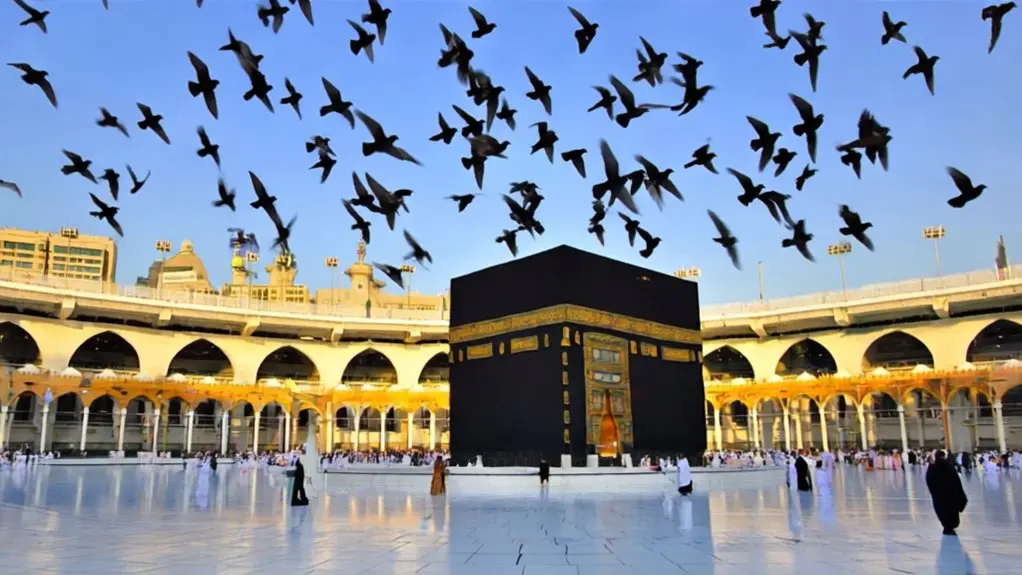
You can observe birds freely flying over and perching on the Kaaba, which goes against common myths that say they avoid this sacred site. Scientific evidence shows that birds behave naturally, influenced by ecological factors rather than any religious significance. There are no physical or environmental deterrents stopping them from flying or resting on the Kaaba’s structure.
These myths mostly stick around because of cultural reverence and anecdotal stories, not because of what’s actually observed. When you look into how birds behave around the Kaaba, it gives you some pretty interesting insights that go beyond popular misconceptions.
Can Birds Really Fly Over The Holy Kaaba?
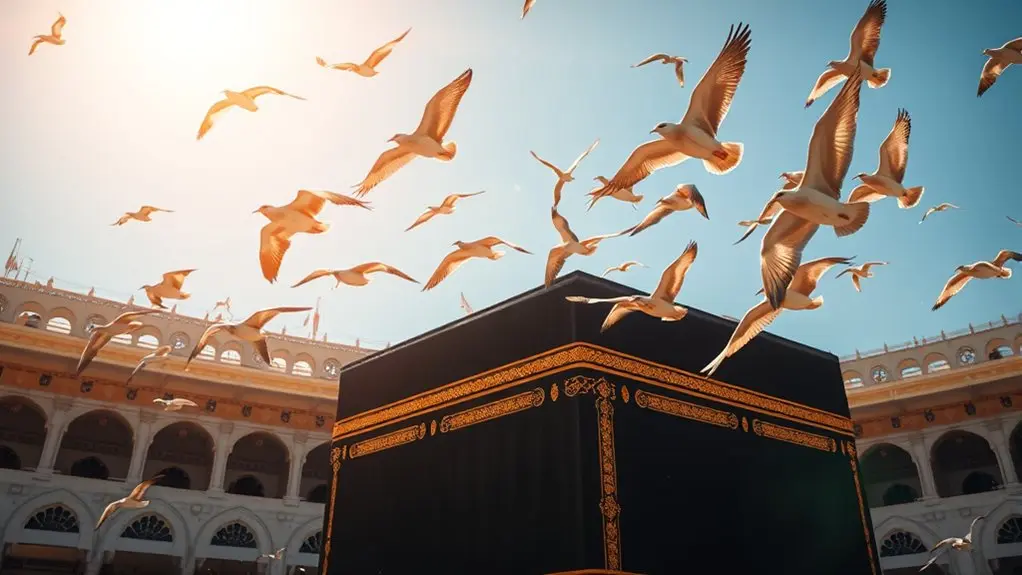
Have you ever wondered if birds really avoid flying over the Holy Kaaba? Despite the historical symbolism and ritual significance that surround this sacred site, scientific observations show no evidence that birds refrain from flying over or perching on the Kaaba.
Birds, including pigeons, commonly fly above and rest on the Kaaba’s roof, exhibiting natural flight behavior consistent with their species. The claim that birds avoid this area lacks support from empirical data.
In fact, frequent sightings of birds around the Kaaba confirm that there are no physical or environmental barriers deterring their flight. This understanding separates myth from reality, emphasizing that while the Kaaba holds profound religious meaning, bird behavior around it aligns with typical avian patterns rather than symbolic avoidance.
How Do Birds Behave Around The Kaaba?
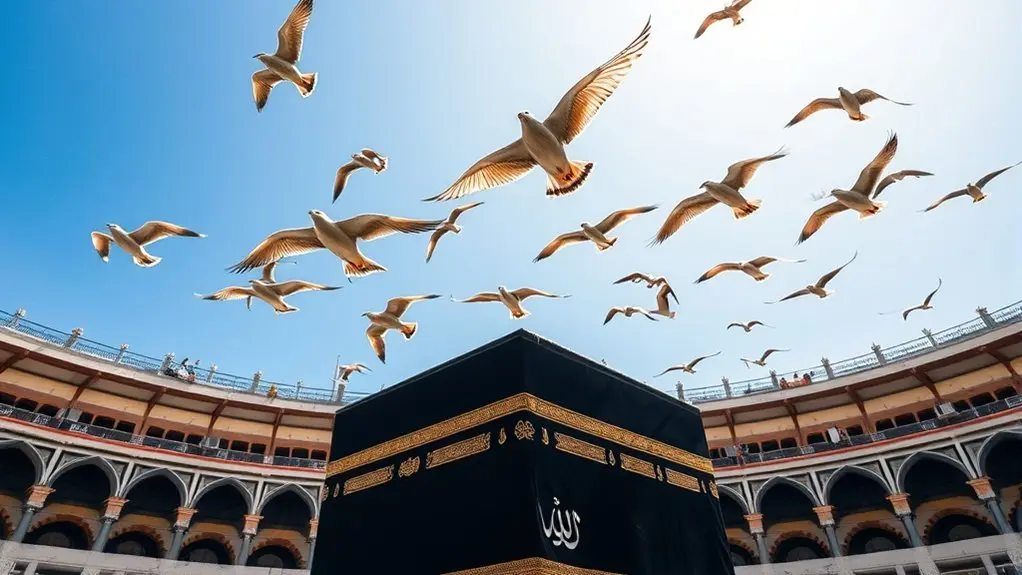
You’ll often see birds, like pigeons, comfortably resting on the roof of the Kaaba without any disturbance. They seem completely at ease there.
When they fly around the site, their movements don’t show any signs of avoiding or being restricted by the area. Basically, their behavior is just what you’d expect from birds in this region.
Birds Perching On Kaaba
Although some claims suggest otherwise, birds such as pigeons frequently perch on the roof and surrounding areas of the Kaaba without hesitation. This behavior aligns with their natural nesting habits and resting patterns observed in urban environments.
During bird migration, many species seek safe resting spots, and the Kaaba’s structure provides an accessible perch.
Scientific observation confirms no avoidance or unusual behavior from birds around this site. The consistent presence of birds on the Kaaba reflects typical avian behavior rather than any specific restriction or taboo.
You’ll notice that their perching is part of normal bird ecology, where they exploit available architectural features for rest and nesting opportunities during migratory or local movements.
Claims denying this contradict clear evidence and established ornithological understanding. So, it’s pretty straightforward—birds just do what birds do, using whatever safe spots they can find.
Flight Patterns Around Kaaba
How do birds navigate the airspace above the Kaaba? Birds, including pigeons, show flight patterns typical of their species without any change when flying over or near the Kaaba. Scientific observations show no shift in their migration patterns because of the structure or location.
Their nesting habits stay the same, with some birds sometimes perching or nesting on the Kaaba’s roof. This is similar to what you’d see at other religious or urban sites. Birds follow natural flight routes, landing and taking off freely.
This means they don’t avoid the airspace above the Kaaba. These behaviors match what ornithologists expect, showing that birds treat the Kaaba’s area like any other part of their habitat. There’s no impact from any special environmental or cultural factors.
Do Birds Sit On The Roof Of The Kaaba?
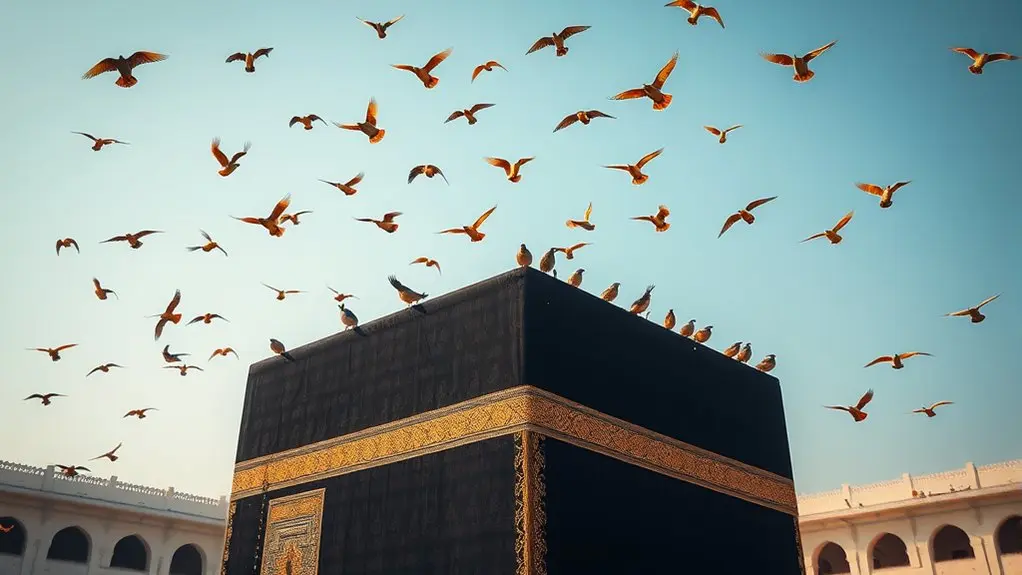
Because birds naturally seek elevated perches, pigeons and other species frequently sit on the roof of the Kaaba. This behavior aligns with typical avian patterns, as birds use prominent structures for rest and observation.
Some people assume birds avoid the Kaaba because of its historical symbolism and cultural significance. But scientific observations don’t show any evidence of that.
Birds interact with the Kaaba just like they’d with any other architectural feature, perching on edges and elevated surfaces.
Their presence on the roof is normal ecological behavior, not anything mystical or supernatural.
Understanding this clears up misconceptions. It shows that bird activity near the Kaaba follows general natural tendencies, not unique cultural or religious rules.
What Common Myths About Birds And The Kaaba Are False?
Why do some myths claim that birds avoid flying over or perching on the Kaaba? These misconceptions often come from bird symbolism and religious symbolism, which lead people to think there are supernatural reasons behind it. But if you look closely, scientific observation shows these claims aren’t true.
Here are four common false myths:
- Birds never land on the Kaaba’s roof, suggesting it’s sacred and untouchable.
- Birds avoid flying overhead because of divine protection.
- The absence of birds near the Kaaba means it has special spiritual sanctity.
- Bird behavior around the Kaaba is guided by religious symbolism instead of natural instincts.
In reality, birds freely fly over and perch on the Kaaba just like they do anywhere else. Their behavior isn’t influenced by the religious significance of the site. These myths don’t have any real evidence behind them and just misunderstand how birds act by reading too much into symbolism.
Is There Any Scientific Reason Birds Avoid The Kaaba?
Although many people believe birds avoid flying over the Kaaba, scientific observations show no evidence supporting this claim. Birds, including pigeons, freely fly over and rest on the Kaaba’s roof, demonstrating normal flight behavior.
From a scientific standpoint, bird migration and flight patterns are governed by ecological influences such as food availability, weather, and habitat rather than religious or cultural landmarks.
The Kaaba doesn’t emit any physical or environmental factors that would deter birds.
Studies of bird migration routes confirm that birds navigate using natural cues like the earth’s magnetic field and visual landmarks unrelated to the Kaaba.
Why Do These Bird Myths About The Kaaba Persist?
Even when direct observations show birds flying and resting on the Kaaba, myths about their avoidance continue to thrive. These myths persist because of several factors rooted in historical symbolism and religious beliefs.
First, there’s a strong cultural emphasis on the Kaaba’s sanctity, which encourages stories that portray it as untouched by ordinary creatures.
A deep cultural reverence for the Kaaba fosters tales of it being untouched by ordinary creatures.
Then, religious interpretations often attribute miraculous qualities to the Kaaba, reinforcing the idea that birds avoid it.
Also, there’s been a lack of focused scientific research on bird behavior around the Kaaba, which leaves plenty of room for misconceptions to spread.
On top of that, anecdotal stories and traditional accounts get shared widely, often overshadowing actual evidence about bird activity.
What Does Bird Behavior Reveal About The Kaaba’s Significance?
When you observe birds around the Kaaba, you’ll notice they behave just as they do in any other urban environment. They perch, fly, and rest without hesitation. This normal avian activity shows there are no natural deterrents linked to the site’s religious significance.
The behavior highlights that the Kaaba’s importance is rooted in cultural symbolism and religious meaning, not biological factors.
| Aspect | Observation |
|---|---|
| Bird activity | Normal flight and perching |
| Natural deterrents | None detected |
| Biological impact | No effect on bird behavior |
| Cultural symbolism | High, unrelated to bird presence |
Frequently Asked Questions
What Types of Birds Are Commonly Seen Near the Kaaba?
You’ll commonly see pigeons, sparrows, doves, and storks near the Kaaba. Ornithological studies highlight bird migration patterns, revealing these species’ seasonal presence.
This reflects typical urban bird activity rather than any avoidance of the sacred site. It’s interesting how these birds just go about their usual routines, even in such a significant place.
How Do Pilgrims Interact With Birds Around the Kaaba?
You’ll notice pilgrims gently observe birds around the Kaaba, embracing bird symbolism tied to peace and spirituality. Their interactions reflect religious significance, blending reverence with respect.
They maintain natural behavior without disturbance or interference during rituals. It’s a beautiful balance of honoring both faith and nature.
Are There Any Cultural Stories Involving Birds and the Kaaba?
You won’t find any mythical stories or bird symbolism specifically tied to the Kaaba. Scientifically, birds are part of the natural environment.
Cultural narratives rarely associate them with this sacred Islamic site. So, when it comes to the Kaaba, birds don’t really play a symbolic or legendary role. It’s more about the spiritual and religious significance of the place itself.
Do Birds Nesting Near the Kaaba Affect Its Cleanliness?
You won’t find birds nesting near the Kaaba affecting its cleanliness considerably, as bird behavior is monitored carefully. Maintenance challenges are promptly addressed through regular cleaning. This ensures hygienic conditions remain consistently intact.
How Is Bird Protection Managed Around the Kaaba Area?
You won’t find formal bird conservation or urban bird management around the Kaaba. Instead, birds naturally coexist there, with no specific protection measures in place.
This reflects a balance between religious sanctity and the birds’ inherent freedom to fly and perch. So, it’s more about letting nature take its course while respecting the sacred environment.
Conclusion
You might be surprised to learn that birds do fly over and even perch on the Kaaba’s roof, debunking popular myths. Scientific observations show no natural avian avoidance; their behavior aligns with typical bird patterns influenced by environment, not mystical forces.
So, why do these myths persist? It’s a mix of reverence and storytelling. Understanding bird behavior objectively reveals more about human perception than about the Kaaba itself. It’s an insight worth pondering.