
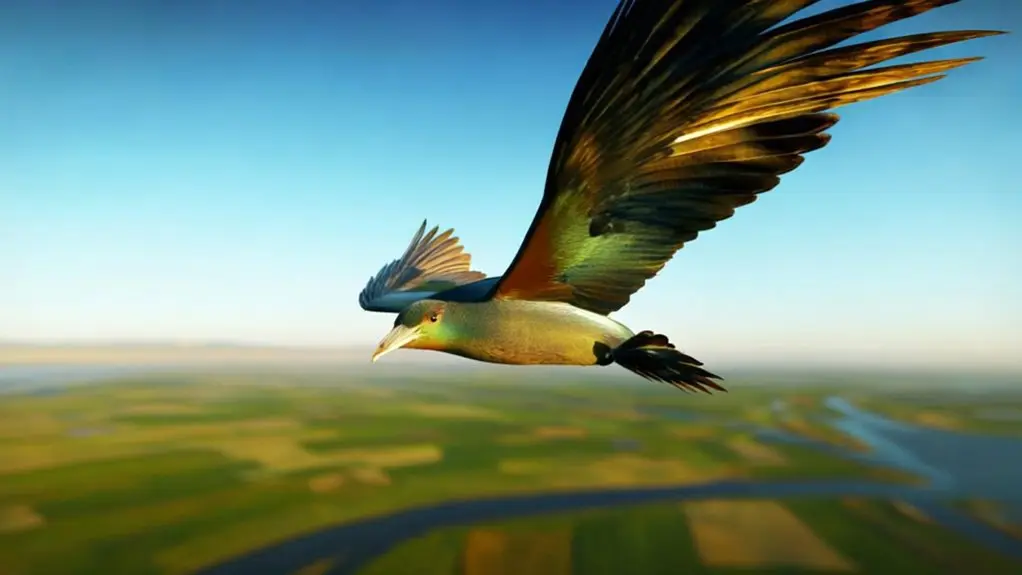
Yes, birds can fly to other countries by following established flyways, which are natural migration routes linking breeding and wintering areas across borders. About 20% of bird species cross countries using environmental cues like the sun, magnetic fields, and landmarks for navigation.
They rely on stopover sites to rest and refuel during these long journeys. But they do face threats like habitat loss and collisions along the way.
Understanding their migration patterns helps us appreciate their remarkable endurance and the important roles they play in global ecology. It’s pretty amazing how they manage these long trips!
How Do Birds Migrate Between Countries?

Although migrating between countries involves vast distances and complex routes, birds navigate these journeys by following specific flyways that link their breeding and wintering grounds. You’ll find that their bird feather structure plays a critical role in enabling efficient flight over long distances, minimizing energy expenditure.
Their nesting habits influence the timing and direction of migration, as birds must return to precise breeding sites after wintering.
Environmental cues like the sun, stars, magnetic fields, and landmarks guide them during these travels, while stopover sites provide essential refueling points.
Migration routes are often genetically encoded but can also be learned from experienced birds.
Altogether, these factors allow birds to cross international borders successfully, maintaining survival and reproduction cycles across continents.
Which Bird Species Migrate Across Countries?

You’ll find that around 2,000 bird species regularly migrate across countries, following specific regional patterns. Some birds, like the UK-breeding Swallow and the Arctic Tern, make incredible long-distance journeys that connect multiple continents.
It’s fascinating to see how these species navigate such vast distances. By understanding these birds and their migration routes, we get a clearer picture of how migration helps shape ecosystems across borders.
Migratory Bird Species
When you observe bird migration, you’ll notice that about 2,000 species, roughly 20% of the world’s total, regularly cross international borders. These migratory birds have distinct feather coloration and nesting behaviors that are adapted to their seasonal journeys.
For example, UK-breeding swallows migrate to southern Africa during winter, showing some amazing long-distance intercontinental movement.
Arctic terns travel over 49,700 miles every year between polar regions. That’s one of the longest migrations you’ll find in the bird world.
Key migratory bird species include warblers and thrushes, which use specific flyways for migration. Shorebirds like the Bar-tailed Godwit migrate thousands of miles between breeding and wintering grounds.
Then there are Blackpoll Warblers, known for their transnational flights and feather coloration that helps with camouflage.
These species also change their nesting behaviors depending on where they’re and the season. It’s fascinating how they adapt to different geographic locations.
Regional Migration Patterns
Understanding which bird species migrate across countries reveals patterns that reflect ecological adaptations and geographic influences. Approximately 20% of bird species, like UK-breeding Swallows and North American songbirds such as the American Robin, cross national borders following established flyways.
Species like the Blackcap and Cuckoo migrate within Europe, choosing nesting sites that optimize survival.
Feather coloration often plays a role in species recognition during these migrations, aiding birds in locating appropriate breeding grounds. While Arctic Terns undertake extreme cross-continental journeys, many regional migrants focus on shorter routes between specific countries.
These patterns show how migration is shaped by ecological needs, such as finding suitable nesting sites, and geographic constraints.
Recognizing these behaviors helps you understand the complexity of avian migration across regions. It’s pretty fascinating to see how birds navigate and adapt to different environments during their journeys.
Notable Long-Distance Travelers
Although many bird species migrate within regional boundaries, several undertake remarkable long-distance journeys that span multiple countries and continents. These notable travelers exhibit unique feather coloration and nesting behaviors that support their endurance and reproductive success across vast ranges.
Consider these examples:
- Arctic Terns migrate over 49,700 miles annually between Arctic breeding grounds and Antarctic non-breeding areas, crossing numerous countries.
- Bar-tailed Godwits perform nonstop flights nearing 7,000 miles from Asian breeding sites to Australian wintering grounds. They rely on energy-efficient feather structure to make these incredible trips.
- Barn Swallows travel from Europe to Africa each season and show adaptive nesting behaviors along migratory routes. These adaptations help them survive the journey and thrive in different environments.
What Are the Main Migratory Flyways Between Countries?

You’ll find that birds migrate along major global flyways like the Atlantic, Pacific, and East Asian-Australasian routes. These paths connect breeding and wintering areas across different continents.
These flyways often follow natural landmarks such as coastlines and mountain ranges. That way, birds can navigate thousands of miles between countries more easily.
It’s pretty fascinating how birds use environmental cues and their built-in navigation skills to find their way. Understanding this helps us map out their migratory routes better.
Major Global Flyways
When birds migrate between continents, they follow established routes known as global flyways. These flyways are critical for habitat preservation, as they connect breeding and wintering grounds across vast distances. Comprehending these corridors also helps assess climate impact on migratory patterns.
The main global flyways include the Atlantic, Pacific, Central, and Mississippi flyways, linking North America with Central and South America.
Then there’s the East Asian-Australasian Flyway, which stretches over 19,000 miles from Siberia and Japan to Australia and New Zealand.
Another important one is the African-Eurasian Flyway. It connects Europe and Asia with Africa and supports millions of migrating birds seasonally.
Also, the Central Asian Flyway spans from Siberia and Mongolia to South Asia, crossing important countries like India and Kazakhstan.
These flyways make sure migratory species have a safe passage and the resources they need worldwide.
Flyway Navigation Methods
Because birds rely on precise navigation to complete their long-distance migrations, they follow established flyways such as the Atlantic, Pacific, and Central Flyways that connect countries across continents. You’ll notice many species use natural landmarks like coastlines, rivers, and mountain ranges to maintain their route.
Celestial cues and Earth’s magnetic field further guide them along these international corridors.
Feather coloration often plays a role in species recognition during migration, helping birds identify conspecifics within crowded flyways.
Nesting behaviors influence timing and destination, as birds migrate to known breeding grounds. Multiple species share these predictable pathways, linking breeding and wintering sites across borders.
However, human-made structures along flyways can disrupt navigation and pose hazards, affecting migratory success between countries. It’s interesting how these challenges impact the birds’ ability to complete their journeys safely.
How Do Birds Navigate During Long International Flights?
Although migrating birds travel thousands of miles across unfamiliar territories, they navigate with remarkable accuracy by using a combination of Earth’s magnetic field, celestial cues like stars and the sun, and recognizable landmarks such as coastlines and mountain ranges.
Bird orientation relies on innate navigation mechanisms and learned behaviors, guided by genetic instincts.
You’ll notice that flock leaders, typically the oldest birds, direct the group along established routes.
When you think about navigation mechanisms, three primary factors really stand out:
- Magnetic field detection enables birds to sense direction even in overcast conditions.
- Celestial navigation, especially star patterns, helps night-migrating species maintain course.
- Environmental cues like wind and weather optimize flight paths.
Together, these systems equip birds for precise long international flights across diverse terrains.
It’s pretty amazing how they combine all these tools to find their way so well!
When Do Birds Migrate Seasonally Across Countries?
Seasonal bird migration happens mainly in spring and autumn. That’s when species move between their breeding and wintering grounds across different countries. For example, in the UK, you’ll notice migration peaks in spring when summer visitors arrive. Then it happens again in autumn as winter visitors return.
The timing of migration depends a lot on environmental cues like day length and temperature. These cues trigger hormonal changes that make sure birds leave and arrive at just the right times. It’s pretty amazing how they get it so spot on.
Some species, like Swallows and Blackbirds, travel thousands of miles between countries. Arctic Terns go even further, crossing multiple continents.
What Dangers Do Migratory Birds Face?
When migratory birds set out on their long journeys, they encounter numerous hazards that threaten their survival. You should understand these dangers to appreciate the challenges birds face.
Key threats include collisions with tall structures such as skyscrapers, wind turbines, and power lines. Urban lighting at night makes things worse by disorienting birds.
Extreme weather events also cause disorientation and exhaustion, which increases the risks of death during migration.
Habitat loss is another big problem, especially when it affects crucial resting spots like wetlands. These areas are vital for birds to refuel and recover.
There are other dangers too, like predation by introduced species and illegal hunting. All these factors together make bird conservation efforts much harder worldwide.
Recognizing these threats is key if we want to create effective strategies to protect migratory birds and help them travel safely across countries.
How Can We Help Migratory Birds?
How can you contribute to protecting migratory birds during their journeys? First, reduce collisions with tall structures by supporting bird-safe window designs and minimizing artificial nighttime lighting. These measures lower the risk of disorientation caused by altered perception of feather coloration under artificial light.
Reduce bird collisions by supporting bird-safe windows and cutting artificial nighttime lighting to prevent disorientation.
Also, protect and restore critical stopover habitats, like wetlands and forests, that provide essential resources for refueling and resting. These spots are vital for maintaining natural nesting behaviors and successful migration.
Understanding how feather coloration signals influence behavior can really help improve conservation strategies.
Support international agreements like the Migratory Bird Treaty to guarantee protection across borders. Finally, raising awareness about threats encourages community involvement in habitat preservation and helps reduce risks to migratory birds during their long flights between countries. Your actions directly impact their survival and the ecological balance.
Frequently Asked Questions
Do Birds Communicate During Migration Between Countries?
Yes, you’ll find bird communication vital during migration. Birds use migration signals like vocal calls and visual cues to coordinate movements, share navigation information, and maintain flock cohesion across countries.
This helps ensure safer, more efficient journeys. It’s pretty amazing how they manage to stay in sync over such long distances. Communication really makes a big difference!
How Fast Do Birds Fly During International Migration?
You’ll see birds flying at speeds ranging from 15 to 55 miles per hour during international migration. Their migration timing and flight speed depend on energy conservation and predator avoidance.
They often fly at night to keep pace efficiently. It’s pretty amazing how they manage such long journeys, right? Flying at night helps them stay safe and use their energy wisely.
Can Birds Rest on Water During Long Migrations?
Yes, you’ll find many migratory birds use water resting to boost migration endurance. They land on water surfaces to sleep, feed, and recover energy. This helps them sustain long-distance flights over oceans or continents effectively.
It’s pretty amazing how they manage to pause mid-journey like that. Resting on water gives them a chance to recharge without needing to find land. So, next time you see birds floating calmly on a lake during migration season, you’ll know why they’re there!
Do All Birds Migrate Internationally or Only Some Species?
Only some species migrate internationally, guided by bird navigation instincts. You’ll notice migratory bird conservation focuses on these species.
Many birds migrate locally or remain resident, depending on their genetic programming and environmental needs. It really varies from one species to another.
How Do Weather Changes Affect Bird Migration Routes?
You’d think weather changes could stop birds mid-flight! Climate change and habitat loss disrupt their routes, forcing detours or delays. These fluctuations alter timing, increase energy costs, and threaten survival.
It’s like a delicate balance that migration depends on, and when it’s off, birds really feel it. They might have to fly farther or rest in places they usually wouldn’t. All of this adds up to a tougher journey overall.
Conclusion
You might be surprised to learn that some birds travel over 7,000 miles during migration, crossing multiple countries and continents. These incredible journeys rely on precise navigation and timing, highlighting birds’ remarkable adaptations.
Understanding their routes and challenges is crucial for protecting them. By supporting conservation efforts and preserving habitats, you can help guarantee these migratory species continue their essential international flights for generations to come.