
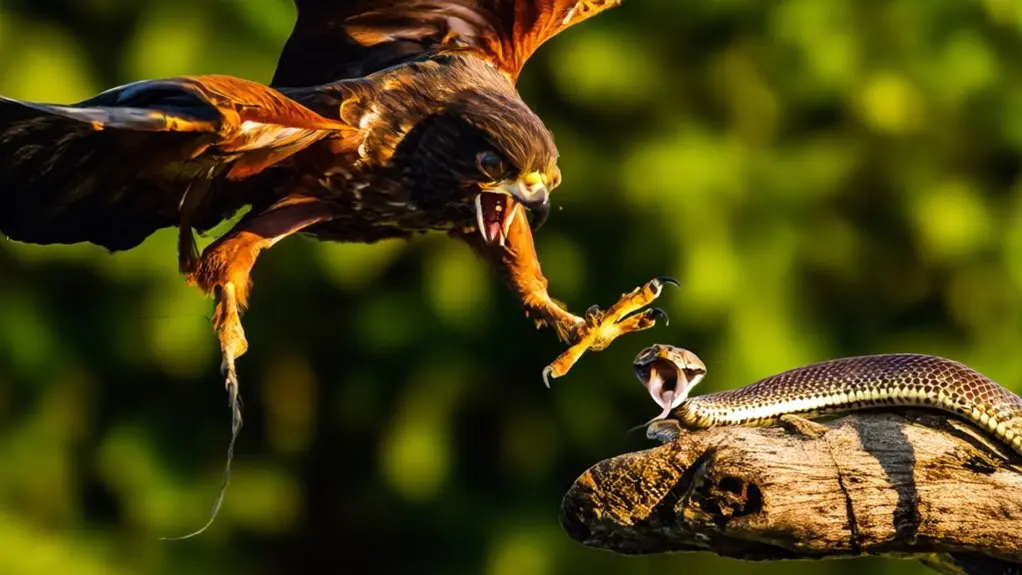
Yes, birds can kill snakes by relying on sharp vision, precise strikes, and agile movements rather than venom resistance. They use keen eyesight to detect snakes from afar and employ rapid, targeted attacks aimed at vulnerable areas like the neck.
Birds also use wing distraction and camouflage to approach stealthily, which helps minimize risk. This physical and behavioral strategy is quite different from mammals’ venom immunity, showing how evolution has come up with diverse ways to survive.
Understanding these tactics gives us a better look into how predators and prey interact and what it takes to stay alive out there. It’s pretty fascinating when you think about all the clever tricks animals use!
Bird Hunting Strategies Without Venom Resistance
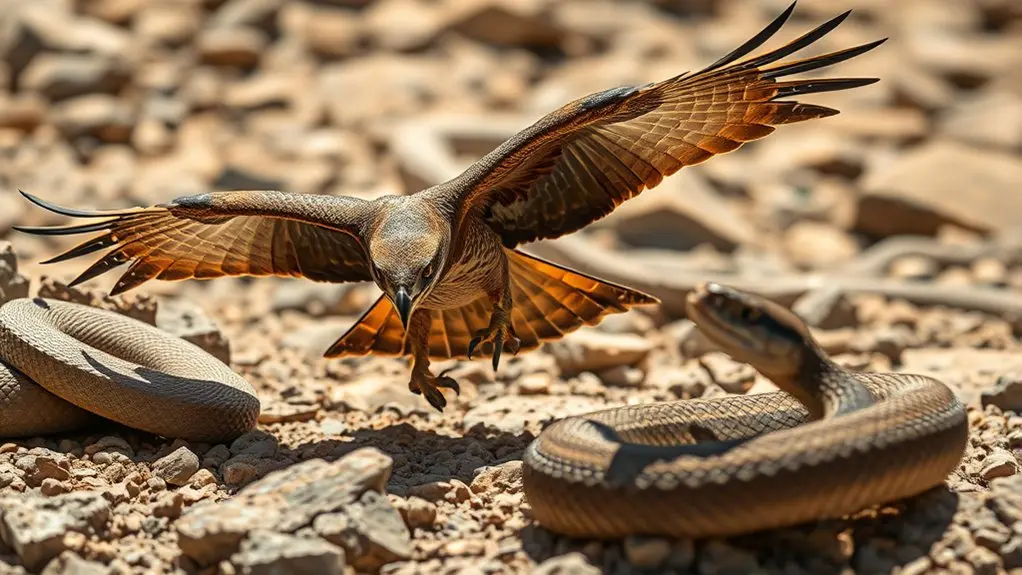
Although birds of prey and snake-eating birds lack genetic venom resistance, they effectively hunt snakes by relying on keen vision, agility, and specialized behaviors. You’ll notice that feather camouflage plays a vital role, allowing birds to blend into their environment and approach snakes without detection. This stealthy approach reduces the risk of provoking a defensive strike.
When it’s time to attack, beak precision is essential. Birds target vulnerable areas like the back of the snake’s neck to incapacitate it swiftly.
Their wings may also be used strategically to distract or confuse the snake, giving you the upper hand in the encounter.
These combined strategies compensate for the absence of venom immunity. It really shows how birds have adapted through physical and behavioral tactics rather than genetic changes. Pretty remarkable, right?
Physical and Behavioral Adaptations That Help Birds Kill Snakes
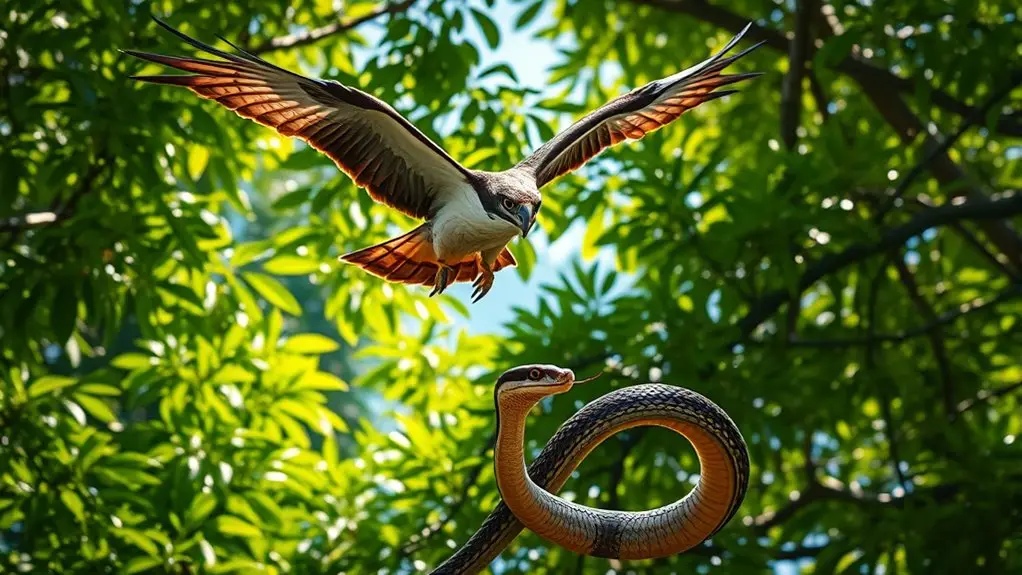
You rely on keen vision and swift agility to spot and get close to snakes with precision.
Using wing distraction tactics, you can cleverly shift the snake’s focus, giving yourself a perfect chance to strike.
Vision and Agility
When birds of prey and snake-eating species spot their quarry, they rely on exceptional vision to detect snakes from a distance and accurately plan their attack. Their advanced color vision enhances prey detection by distinguishing subtle contrasts between the snake and its environment, enabling precise targeting.
Once sighted, birds utilize remarkable agility to swiftly dodge strikes, avoiding the snake’s defensive moves. This agility also allows them to maneuver into the most suitable positions for precise pecking, primarily targeting the snake’s vulnerable neck region.
These combined physical adaptations of keen vision and dexterous movement increase hunting success while minimizing risk. By integrating accurate visual assessment with rapid, controlled actions, birds effectively neutralize snakes despite lacking venom resistance.
It’s a finely tuned evolutionary strategy that really shows how well these birds have adapted to their challenging prey.
Wing Distraction Tactics
Building on their keen vision and agility, birds deploy wing distraction tactics to gain an advantage over snakes. By opening their wings wide, they use wing signaling to create a dynamic visual display that confuses or intimidates the snake. This diverts its attention away from the bird’s body.
This tactic lowers the risk of a venomous bite, letting you approach the snake more safely. Plus, feather camouflage helps birds blend into their surroundings when their wings are folded. That way, they can launch surprise attacks.
The combination of wing signaling and feather camouflage works as both a defensive and offensive strategy. It makes up for the fact that birds don’t have venom resistance.
These physical and behavioral adaptations boost your ability to neutralize snakes effectively without making direct contact with their fangs.
Strategic Pecking Methods
Although snakes pose significant danger with their venomous bites, birds have evolved strategic pecking methods that minimize risk while maximizing hunting success. You’ll notice birds use sharp beaks to precisely peck at the back of a snake’s neck, avoiding its fangs and venomous strikes.
Their high agility and quick reflexes allow rapid strikes, while opening wings distracts the snake’s attention, creating an opening for attack.
Birds also employ camouflage tactics to approach undetected, blending into surroundings before launching their assault. Additionally, vocal communication helps coordinate group hunting or warn of danger, enhancing effectiveness.
These behavioral adaptations focus on controlled, targeted pecking rather than genetic venom resistance, enabling birds to incapacitate or kill snakes efficiently and safely.
Why Birds Don’t Need Venom Resistance to Hunt Snakes
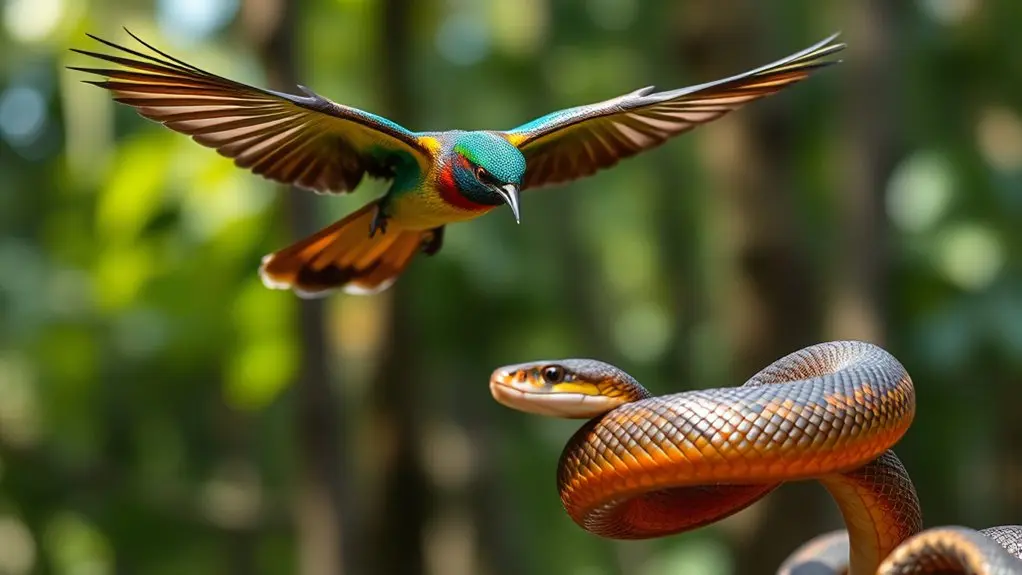
Since birds of prey and snake-eating birds lack genetic resistance to snake venom, they depend on physical adaptations and strategic behaviors to successfully hunt snakes.
Birds of prey rely on physical skills and strategy, not venom resistance, to hunt snakes effectively.
You’ll notice that these birds rely heavily on feather camouflage to blend seamlessly into their environments, minimizing detection by both prey and predators. Nesting concealment further reduces encounters with snakes near their breeding sites, increasing survival rates.
Instead of venom resistance, they capitalize on agility, sharp eyesight, and targeted strikes to vulnerable snake areas. Their evolutionary path emphasizes behavioral tactics over biochemical defenses, allowing them to outmaneuver venomous snakes effectively.
Understanding these adaptations clarifies why birds don’t require venom immunity. They’ve optimized physical and behavioral traits to manage the risks of snake predation within their ecological niche.
How Bird and Mammal Strategies Differ in Snake Predation
When you compare how birds and mammals hunt snakes, clear differences emerge in their evolutionary strategies. Mammals like mongooses and honey badgers develop genetic resistance to snake venom, allowing them to survive bites and consume snakes despite venom risks. This biochemical defense aligns with their dietary preferences for venomous snakes and often corresponds to habitats where venomous snakes are prevalent.
In contrast, birds rely on physical agility, sharp vision, and specific behaviors such as wing distraction and precise pecking to avoid fangs. This reflects a strategy shaped by their habitat influences that favor rapid, visually guided hunting.
Unlike mammals, birds lack venom resistance, which means they emphasize behavioral and morphological adaptations over genetic defenses.
These distinct approaches reveal how dietary preferences and habitat pressures drive divergent evolutionary solutions in snake predation. It’s pretty interesting to see how different animals solve the same problem in their own unique ways.
Evolutionary Insights From Bird Predation on Snakes
Understanding the evolutionary strategies birds use to prey on snakes reveals a distinct path compared to mammals. You’ll notice birds rely on physical agility, sharp eyesight, and strategic behaviors rather than genetic venom resistance.
For example, hawks and eagles use precise wing positioning and targeted pecking at the snake’s neck to avoid venomous fangs.
This behavioral adaptation highlights an evolutionary emphasis on skill and intelligence. Additionally, these predation tactics influence mating behaviors, as successful hunters often attract mates by demonstrating prowess and resource acquisition.
Migration patterns also play a role; birds may adjust routes to follow snake populations seasonally, optimizing feeding opportunities.
This combination of behavioral and ecological factors offers you a clear picture of how avian evolution has shaped their unique approach to snake predation.
Implications of Bird Snake Hunts for Understanding Evolution
Although birds lack genetic venom resistance, their successful predation on snakes shows how physical agility and behavioral strategies can make up for physiological limits. You can see that birds like hawks and eagles use distraction displays and precise pecking to neutralize venomous threats.
It’s a clear example of an evolutionary trade off. Instead of evolving venom resistance, they improved their hunting tactics.
This reveals that genetic diversity in predator-prey interactions drives different adaptive pathways. By studying these behaviors, you get insight into how species evolve various survival mechanisms in response to ecological pressures.
Bird-snake hunts show how evolutionary trade offs shape species’ traits beyond just biochemical defenses. It really enriches your understanding of evolutionary complexity and all the strategies organisms develop to thrive in tough environments.
Frequently Asked Questions
What Types of Snakes Are Most Vulnerable to Bird Attacks?
You’ll find small, ground-dwelling snakes, lacking avian camouflage, most vulnerable to bird nest predators. These snakes are often non-venomous and pretty exposed.
Because of this, they attract birds of prey that actively hunt them for food and to protect their nests. It’s kind of like birds have their own little security system. They keep an eye out for these snakes and swoop in when they spot them.
Do Birds Ever Get Injured by Venomous Snakes?
Yes, during bird migration or nest predation, you risk injury from venomous snakes. Birds can suffer bites if caught off guard, especially without quick reflexes. That makes venomous encounters potentially harmful or even fatal in these vulnerable moments.
It’s kind of like a sudden surprise attack. If a bird isn’t paying attention or can’t react fast enough, the snake’s venom can do serious damage. So yeah, these encounters are definitely risky for birds.
How Do Young Birds Learn to Hunt Snakes?
You’d think bird nest predators would be easy targets, but young birds learn avian hunting tactics through observation. They practice distraction and precise pecking at snakes’ necks. This helps them hone agility and reflexes.
Are Any Bird Species Specialized Snake Hunters?
Yes, you’ll find specialized snake hunters like secretary birds that protect their bird nesting sites by targeting snakes. They use keen eyesight to detect snake camouflage and employ powerful talons along with strategic attacks to subdue these elusive reptiles effectively.
It’s pretty fascinating how they combine sharp vision with quick moves to keep their territory safe. These birds really have a knack for dealing with sneaky snakes!
Can Snakes Defend Themselves Effectively Against Birds?
Yes, snakes can defend themselves effectively against birds by using camouflage, thick scales, and aggressive behaviors. This helps reduce nest predation during bird migration. Predatory birds are actively searching for prey in new territories, so these defenses really come in handy.
Snakes rely on blending into their surroundings to avoid being spotted. Plus, their thick scales offer protection if a bird does try to attack. And when needed, snakes don’t hesitate to act aggressively to protect themselves.
Conclusion
You might be surprised to learn that some birds, like the secretary bird, can kill snakes up to twice their length without venom resistance. Their precise hunting strategies and physical adaptations, such as strong talons and quick reflexes, allow them to overcome these reptiles effectively.
Unlike mammals, birds rely on agility and technique rather than immunity. It’s pretty fascinating how they do it, right? This offers unique insights into evolutionary adaptations.
This highlights the fascinating diversity in predator-prey dynamics across species. Birds and snakes have such different ways of surviving and thriving out there.