
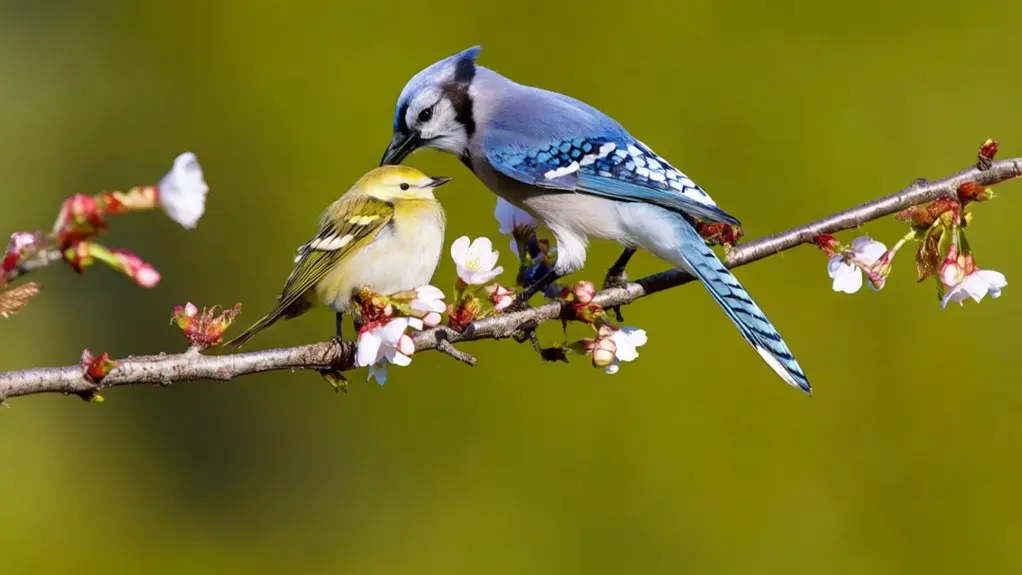
Yes, birds of different species can mate, especially when closely related species share overlapping habitats. Such hybridization is rare but tends to increase with environmental changes like urbanization and climate shifts that disrupt natural barriers.
Hybrids often show mixed traits in their plumage and song, which reveals gene flow and evolutionary dynamics. This process really highlights how species adapt and interact in changing ecosystems.
Keep exploring to understand which species are involved, where hybrid zones exist, and how technology helps uncover these fascinating avian connections. It’s pretty amazing what we can learn about birds and their relationships!
What Is Bird Hybridization And How Common Is It?
Although bird hybridization is relatively rare, it happens when two closely related species mate and produce offspring with a mix of genetic traits from both parents. This process helps boost genetic diversity by combining alleles from different gene pools. Sometimes, this leads to hybrid vigor, where the hybrids are actually fitter than their parents.
You usually find hybridization in hybrid zones where species’ ranges overlap, which creates chances for interbreeding. Changes in the environment, like habitat alteration and climate-driven shifts in where species live, increase these interactions. That means hybridization is becoming more common in some areas.
There are well-known examples, like Brewster’s and Lawrence’s warblers or mallard hybrids, that show how this works. Studying these hybrid birds gives you great insight into how evolution works, where species boundaries lie, and how ecosystems function.
Which Birds Can Hybridize?
Understanding which bird species can hybridize helps clarify how genetic material moves across populations and affects evolutionary processes. Hybridization typically occurs between closely related species within the same genus or family because they’re genetically compatible.
For example, Brewster’s warblers come from two warbler species mating, and mallard hybrids are pretty common among waterfowl.
Mating behaviors also play a role in hybridization. Species with overlapping habitats and similar courtship rituals, like some gulls, pheasants, and grouse, sometimes interbreed.
You’ll also find rose-breasted and black-headed grosbeaks hybridizing where their ranges meet.
Although hybridization is rare, it shows how genetic exchange can happen when reproductive barriers aren’t complete, especially in areas where ranges overlap.
Understanding these patterns helps you get a better grasp of the biological and ecological factors that guide avian hybrid formation.
Where Do Hybrid Birds Usually Appear?
When two related bird species share overlapping geographic ranges, they often form hybrid zones where interbreeding occurs. These zones typically arise in areas impacted by habitat changes, urban expansion, or deforestation, which bring species into closer contact.
You’ll also notice hybrid birds emerging as climate change shifts species’ ranges. At feeders or accessible habitats where multiple species gather, hybrids are more frequently observed. In these zones, feather coloration and song variations often display intermediate traits of parent species, making hybrids identifiable.
Below is a summary of typical hybrid bird locations and characteristics:
| Location Type | Feather Coloration | Song Variations |
|---|---|---|
| Overlapping ranges | Intermediate patterns | Mixed song elements |
| Urban edges | Variable, often blended | Unusual or combined calls |
| High biodiversity zones | Diverse intermediate hues | Novel song sequences |
| Migration overlap | Transitional coloration | Hybridized song motifs |
| Accessible feeders | Mixed parental traits | Song blending observed |
Why Does Bird Hybridization Occur?
Because bird species often share overlapping habitats, hybridization occurs when closely related species encounter each other and mate. This interaction typically happens in hybrid zones where ranges intersect, increasing opportunities for genetic exchange.
You’ll find that habitat modifications, such as urbanization or deforestation, further promote these encounters by altering natural boundaries.
Hybridization plays a significant role in evolutionary processes by introducing new genetic combinations, thereby enhancing genetic diversity within populations. This genetic exchange can lead to the emergence of novel traits or even rare hybrid species.
These changes influence adaptation and survival.
While human activities sometimes intentionally or unintentionally encourage hybridization, it fundamentally reflects the dynamic nature of species interactions and evolution in response to environmental and ecological factors. So, it’s really about how species adapt and respond to the world around them.
How Does Climate Change Affect Bird Hybridization?
You’ll notice that climate change shifts where bird species live, making their ranges overlap more than before. This overlap boosts the chances of different species interbreeding.
On top of that, rising temperatures and changing habitats—especially in cities—affect when and how birds choose their mates. Because of this, different species end up coming into closer contact with each other.
All these changes work together to create new hybrid zones, which give us valuable insights into how birds adapt and evolve when faced with environmental challenges.
Range Shifts And Overlaps
As climate change drives shifts in temperature and habitat, bird species are expanding or moving their ranges. This leads to new areas of overlap with other species. You’ll notice that shifts in migration patterns, influenced by altered climate conditions, cause species with previously distinct ranges to coexist.
For example, green jays have extended their northern range by about 200 miles. This increases habitat connectivity with other species. And when habitats become more connected, you see a rise in hybridization events, as birds encounter potential mates outside their usual species.
This increased overlap facilitates interbreeding opportunities, producing hybrid offspring between species that were once geographically isolated. Understanding these range shifts and overlaps is vital to grasping how climate change directly affects bird hybridization dynamics in natural ecosystems.
Temperature Influence On Mating
When rising temperatures alter migration timing, different bird species can arrive at breeding sites at the same time, increasing the chances of hybridization. Temperature fluctuations mess with breeding schedules by shifting species’ usual mating periods. This lets closely related birds reproduce outside their normal seasons.
These shifts weaken reproductive barriers that used to prevent interbreeding. For example, green jays have moved their range northward by about 200 miles because of warming climates. This creates new overlap zones where hybridization can happen.
As climate change continues, altered temperature patterns cause more frequent overlaps in breeding times and habitats. This fosters hybrid offspring.
You can see how these environmental changes directly contribute to increased hybridization rates by influencing breeding synchronization and migration timing. It really shows how important temperature is in bird mating dynamics.
Urbanization And Habitat Changes
Although climate change drives shifts in temperature and weather patterns, its impact on urbanization and habitat alteration plays a fundamental role in bird hybridization.
As climate shifts force species like green jays to expand their range northward, overlapping habitats increase hybridization chances. Urbanization causes habitat fragmentation, disrupting natural barriers and pushing birds into novel environments where interspecies breeding occurs more frequently.
Additionally, urban noise interferes with species-specific mating calls, weakening reproductive isolation. You should consider these factors: habitat fragmentation from urban sprawl creates mixed-species contact zones. Urban noise disrupts communication essential for mate recognition.
And climate-driven habitat shifts lead to new overlapping ranges and hybrid zones. Together, these changes facilitate hybrid formation by altering habitat structure and reproductive behaviors.
What Can Hybrid Birds Teach Us About Nature?
Because hybrid birds combine traits from different species, they offer a unique window into gene flow and evolutionary dynamics. By studying hybrids, you gain evolutionary insights into how genetic inheritance shapes species adaptation and survival. These birds reveal how reproductive barriers function and how environmental pressures drive speciation or gene exchange.
Observing hybrid traits helps you understand dominance patterns and the resilience of biodiversity amid habitat changes. It’s fascinating to see how these birds blur the lines between species and what that means for nature’s complexity. You start to appreciate the delicate balance between mixing genes and maintaining distinct species.
| Aspect | Insight Provided |
|---|---|
| Gene Flow | How genes transfer between species |
| Genetic Inheritance | Trait dominance and mixing patterns |
| Evolutionary Insights | Adaptation and speciation processes |
| Biodiversity | Species resilience to environment |
| Reproductive Barriers | Mechanisms preventing species mixing |
How Can You Spot Hybrid Birds At Your Feeder?
Understanding the genetic and evolutionary significance of hybrid birds naturally leads to the practical challenge of identifying them in the field.
At your feeder, hybrid birds often show distinctive feather patterns that blend traits from both parent species.
Their song variations may also differ noticeably from the typical calls of either species, giving you another clue.
To spot hybrids effectively, here are some points to consider:
Look for unusual plumage coloration or mixed feather patterns that aren’t typical of local species.
Pay attention to song variations that don’t match known bird calls in your area.
Also, know the native ranges of species around your feeder, since hybrids are more common where ranges overlap.
Keeping these tips in mind can make spotting hybrid birds a lot easier and more fun!
How Technology Helps Identify Hybrid Birds
You can use AI-powered bird identification tools that analyze images and sounds to detect hybrid traits with high accuracy. These tools make it easier to spot subtle differences that might be missed by the naked eye.
Plus, smart feeder technology sends real-time alerts whenever unusual or hybrid species show up. This means you can quickly document these rare visitors without constantly watching the feeder yourself.
By combining machine learning with sensor data, you significantly boost your chances of identifying and studying hybrid birds right in their natural habitats.
It’s a game-changer for bird enthusiasts and researchers alike.
AI-Powered Bird Identification
Though identifying hybrid birds can be challenging because the differences in appearance and behavior are often very subtle, AI-powered bird identification tools have made a big difference in improving accuracy. These tools use advanced image recognition algorithms to spot variations in plumage, size, and patterns, which are key to recognizing hybridization as part of evolutionary adaptation.
On top of that, AI analyzes bird calls to pick up unique vocal signatures. This helps even more in distinguishing hybrids from pure species.
All of this boosts our understanding of genetic diversity within bird populations and provides precise data for scientific research.
- Detects subtle physical traits distinguishing hybrids from pure species
- Analyzes vocal patterns to identify hybrid species
- Provides accurate, real-time data supporting evolutionary studies and conservation efforts
Smart Feeder Technology
While observing birds in their natural habitat can be challenging, smart feeder technology has completely changed how you identify and study hybrid species. These feeders come equipped with advanced cameras and sensors that capture high-resolution images. This helps reveal subtle differences in feather coloration, which is a key sign of hybridization.
They also have integrated microphones that record song variations. This lets you analyze vocal patterns that often differ between species and their hybrids.
Machine learning algorithms then process all this visual and acoustic data to classify birds accurately, distinguishing hybrids from parent species.
By monitoring these traits in real-time, you can keep track of hybridization events as overlapping ranges shift because of climate change. This precise, technology-driven approach really boosts your ability to document rare hybrids.
Plus, it provides essential data for ecological research and helps deepen our understanding of avian interspecies mating dynamics.
Detecting Unusual Species
Building on smart feeder technology’s ability to capture detailed visual and acoustic data, detecting unusual species has become more precise and efficient. You can now rely on AI-enabled systems to analyze genetic markers and morphological traits that differentiate hybrids from pure species. These technologies use machine learning models trained on vast bird datasets to enhance identification accuracy.
Automated cameras monitor natural habitats, capturing subtle plumage variations and behaviors indicative of hybridization. Plus, smartphone apps let you verify suspected hybrid birds by comparing their features against known hybrid profiles.
Key advantages include:
- AI analysis of images and sounds for hybrid detection
- Identification based on genetic markers and morphological traits
- Real-time verification through smartphone applications
This integration of technology considerably advances your ability to detect and study unusual bird species.
Frequently Asked Questions
Are Hybrid Birds Fertile or Sterile?
Hybrid birds’ fertility depends on genetic compatibility. If the species are closely related, you’ll often find better breeding viability, like with mallards.
But when the species are more distant, hybrids are usually sterile because of genetic differences. This limits successful reproduction and the chances of viable offspring.
Can Hybrid Birds Survive Long in the Wild?
Yes, hybrid birds can survive long in the wild if they benefit from genetic diversity and hybrid vigor. These factors enhance their adaptability and resilience. Because of that, you can often see their success in different environments.
That said, they might face some challenges with fertility. But overall, their mixed genetics can give them an edge in the wild. It’s pretty interesting how nature works, right?
Do Hybrid Birds Have Unique Behaviors?
You’ll notice hybrid songbirds like Brewster’s warbler display unique behaviors, such as mixed plumage and distinct song patterns. These blends affect their courtship and territory defense.
It’s pretty interesting how hybrid birds often show novel, intermediate behaviors that aren’t exactly like either parent species. This mix really sets them apart in the bird world.
Can Hybrid Birds Be Kept as Pets?
You can keep hybrid birds as pets if genetic compatibility is guaranteed. But be aware of breeding restrictions and potential health issues.
Always source from reputable breeders who prioritize ethical practices and genetic health. This helps you avoid complications down the line. It’s worth taking the time to find a trustworthy source.
How Do Hybrid Birds Affect Local Ecosystems?
Isn’t it great when hybrid birds disrupt genetic diversity? Actually, you’ll find they can unbalance ecosystems, altering predator-prey dynamics and resource use.
This threatens ecosystem balance and may reduce native species’ survival chances over time. It’s not something to take lightly when thinking about local wildlife.
Conclusion
Bird hybridization is like nature’s experimental laboratory, mixing genetic codes to reveal new possibilities. You’ll see it mostly where species’ ranges overlap, influenced by environmental shifts like climate change. Understanding these hybrids helps you appreciate evolution’s ongoing process and the delicate balance in ecosystems.
By observing and using modern technology to identify hybrids, you contribute to uncovering nature’s intricate patterns. This enhances our scientific knowledge and supports conservation efforts. It’s pretty amazing how much we can learn just by paying attention to these natural experiments.