
You can find bird twins, but they’re very rare and form mainly from double-yolked eggs or, less often, from a single fertilized egg splitting. Twins face tough challenges inside one eggshell, like space, oxygen, and nutrient limits, causing high embryo mortality.
Even if hatched, twins compete fiercely for food, which lowers their chances of survival. Most twin occurrences remain anomalous and hard to document. But ongoing observations reveal more about their development and the complexities of their survival.
What Are Bird Twins and How Do They Form?
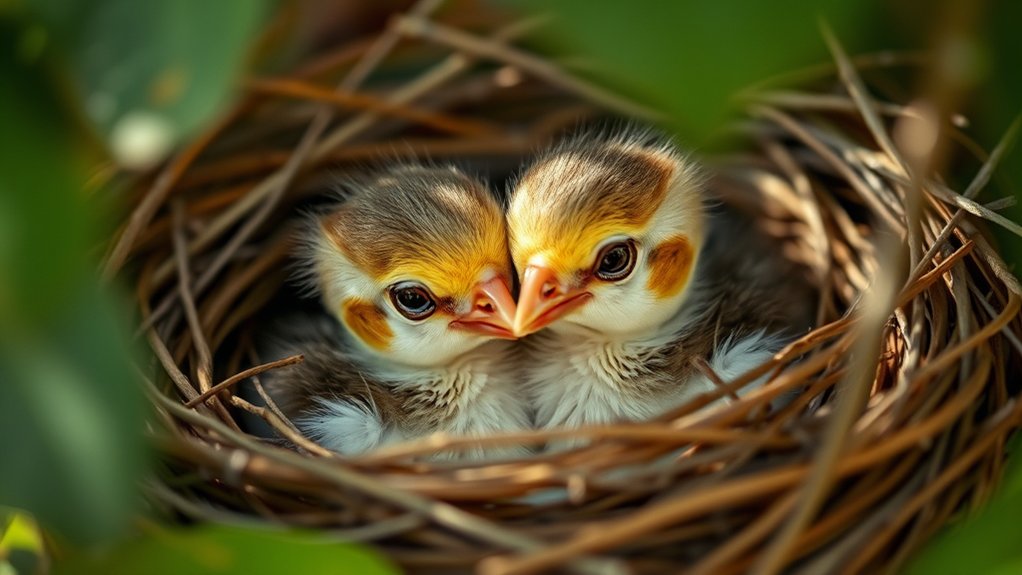
Although bird twins are uncommon, they can form either as fraternal twins from two separate eggs or, more rarely, as identical twins when a single fertilized egg splits.
Bird twins are rare, forming as fraternal from separate eggs or, more rarely, identical from one split egg.
Fraternal twins typically develop from double-yolked eggs, which happen when two ova are released at the same time or a yolk gets temporarily stuck in the oviduct.
These double-yolked eggs create the environment for two embryos to grow side by side.
Identical twins, on the other hand, come from the splitting of a single fertilized egg, which is a rare and complex biological event.
Even though twins can form, many embryos don’t survive to hatching because of high mortality rates.
To really understand how bird twins come about, you need to look at avian reproductive physiology.
Bird twin formation is rare but it’s a natural process controlled by specific developmental mechanisms.
How Common Are Twins in Wild Birds and Eastern Bluebirds?
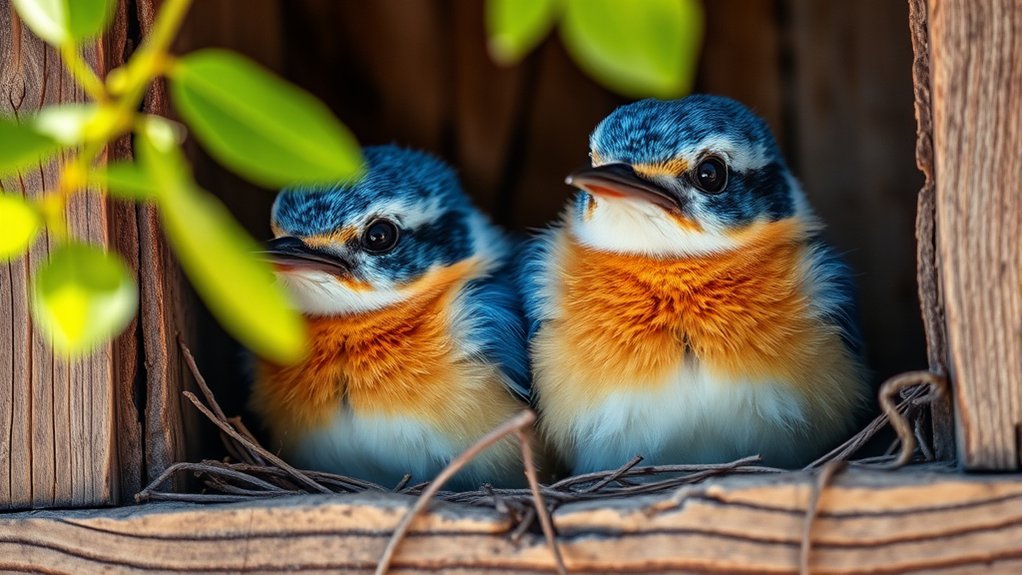
The formation of bird twins, while biologically possible, remains an exceptionally rare occurrence in wild populations. Documented cases of twins exist in only a few bird species, and their incidence is extremely low.
For eastern bluebirds, no confirmed twin nestlings appeared in scientific or citizen science records before 2013.
Most wild birds, including eastern bluebirds, typically lay single eggs, making twin hatchlings an extraordinary event. Double-yolked eggs, which can give rise to twins, are uncommon and often fail due to embryo death or unsuccessful hatching.
When twin bluebird nestlings do occur, they’re considered rare natural anomalies, with only a handful of documented instances worldwide.
How Do Double-Yolked Eggs Lead to Bird Twins?
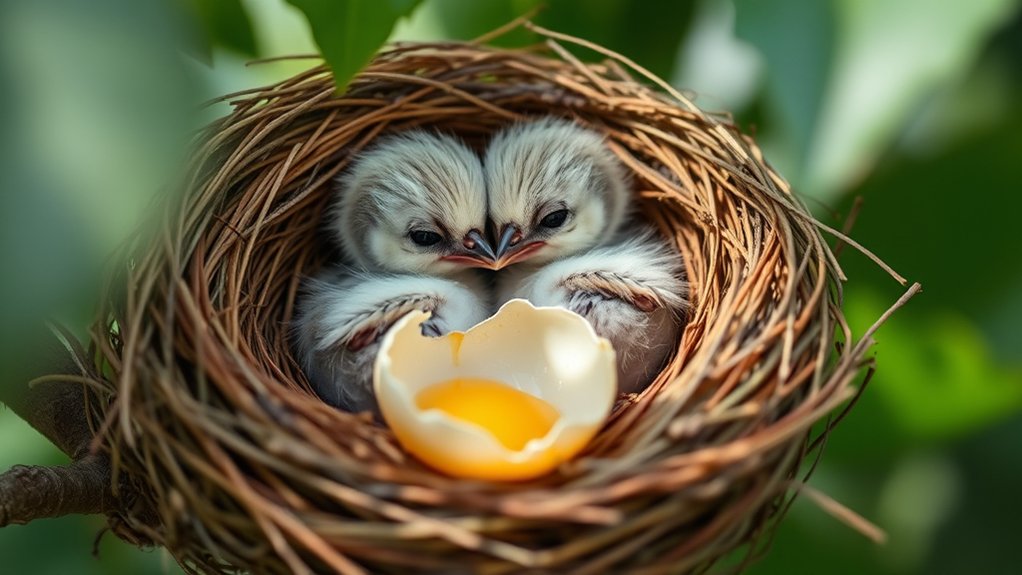
You know, double-yolked eggs happen when a hen releases two yolks at the same time or when one yolk gets stuck in the oviduct. This results in a single eggshell with two yolks inside.
If both yolks end up fertilized, they can actually develop into twin embryos.
But here’s the catch—those twins face some serious challenges because there’s limited space and oxygen inside the egg.
Formation of Double Yolks
Two yolks released from a hen’s ovary within a short time frame can combine to form a double-yolked egg, creating the potential for bird twins. This happens mostly in young or reproductive-immature hens and involves multiple ovulations. Here’s what you need to know:
Double-yolked eggs are larger because they’ve two yolks and extra shell material. Each yolk can develop into an embryo, so there’s a chance for twins. But the embryos have to compete for limited resources and oxygen inside the egg.
Because of that competition, high mortality rates happen before hatching. Successful twin hatchings are rare but possible when both embryos survive early development.
Understanding double yolk formation helps explain the biological basis for bird twins, though their survival remains challenging.
Development Challenges for Twins
Although double-yolked eggs create the possibility for bird twins, you have to think about the big developmental challenges that come with these tight spaces. When a hen ovulates two yolks at the same time or really close together, both embryos have to share a cramped environment. They end up competing for oxygen, nutrients, and physical space.
This competition often leads to embryonic death, especially during key development stages between days 7–14 and 18–23. The fact that double-yolked eggs are bigger also makes incubation harder and increases the chances of death.
Because of these physical and biological limits, most double-yolked eggs don’t hatch successfully. Twin embryos might start developing okay, but the limited resources and tight space usually stop both from making it to hatching.
It really shows how tough it’s for bird twins to come from double-yolked eggs.
Why Are Twin Bird Embryos Rare and Hard to Hatch?
Because twin bird embryos develop within the confines of a single eggshell, they face significant challenges that reduce their chances of survival. You should know these key factors make twin embryos rare and hard to hatch:
Double-yolked eggs suffer over 64% embryo mortality in the first week. Limited oxygen supply inside one egg restricts both embryos’ access to pores. Competition for nutrients and space within the eggshell is intense.
Embryonic death often occurs during critical periods, especially days 7–14 and near hatching. Twin formation usually results from abnormal processes like ovum splitting or double yolks but rarely leads to successful hatching.
Understanding these biological constraints explains why twin bird embryos seldom survive to hatch despite occasional formation. It’s a tough journey for those little embryos inside one shell!
What Are Some Known Cases of Twin Birds in the Wild?
You’ll find that documented cases of twin birds in the wild are extremely rare. They mostly involve species like American Goldfinches, Song Sparrows, and some types of waterfowl.
These twins usually come from double-yolked eggs or from identical embryo splitting. However, they face pretty big survival challenges during development and hatching.
Learning about these few confirmed cases really shows just how uncommon natural twin births are among wild bird populations.
Documented Wild Twin Cases
When you examine wild bird populations, documented cases of twin embryos are exceptionally rare and mostly limited to a few species such as American Goldfinches, Song Sparrows, and various waterfowl. Twin embryos in wild birds primarily arise from splitting of a fertilized ovum, resulting in identical twins. However, survival to hatching is uncommon.
Key observations include: twin embryos in waterfowl occur in less than 0.5% of eggs examined. Brown Thrashers and gadwalls also show confirmed twin embryos.
Most twins fail to develop into viable hatchlings due to developmental constraints.
Incidental findings and scientific studies primarily document these cases. Successful twin births in wild populations remain exceedingly rare. You’ll find that twin bird cases in the wild highlight significant biological challenges limiting their prevalence.
Species With Twin Records
Which bird species have documented cases of twins in the wild, and how common are these occurrences? Twin birds are extremely rare, but documented cases exist in species such as American Goldfinches, Song Sparrows, and Brown Thrashers.
Waterfowl, including ducks and geese, occasionally show twin embryo occurrences, though most don’t survive to hatching. Gadwalls and peregrine falcons have confirmed twin embryos, often linked to double-yolked eggs.
Typically, twin hatchlings in the wild are fraternal, arising from separate eggs; identical twins are even more uncommon. Conjoined twins are rarely reported and often questioned due to limited photographic evidence.
Understanding these species with twin records helps you appreciate the rarity and biological constraints affecting twin bird development in natural environments.
Survival Challenges For Twins
How do twin birds manage to survive in the wild despite the numerous biological challenges they face? Twin birds are exceptionally rare, and their survival is hindered by several critical factors. You’ll find documented twin cases primarily in species like American Goldfinches, Song Sparrows, and some waterfowl.
However, the odds are stacked against them due to limited space, oxygen, and nutrients within the egg impacting twin embryo development. High embryo mortality rates often exceed 64% in double-yolked eggs during the first week. Physical constraints also limit growth and movement inside the egg.
On top of that, intense sibling competition reduces the chances of both twins hatching. Environmental stresses further affect embryo viability, especially in waterfowl twins. These challenges make natural twin hatchings extraordinarily uncommon.
It really highlights just how fragile twin bird survival is in the wild.
How Do Twins Affect Nestling Survival and Development?
Although twin nestlings can occur in various bird species, they often face significant challenges that affect their survival and development. You’ll notice increased competition for food between twins, which frequently results in higher mortality rates among the weaker nestlings.
Sibling rivalry can escalate to aggressive behaviors, sometimes harming or killing one nestling. If resources are limited, twins may suffer malnutrition or developmental delays, reducing their chances of healthy growth.
Sibling rivalry among twins can lead to aggression and malnutrition, hindering their healthy development.
In species where twins are rare, you’ll see survival rates drop even more compared to single nestling broods. Environmental factors, such as food availability and parental care, play vital roles in determining whether both twins survive and develop properly.
Understanding these dynamics highlights the complex impact twins have on nestling outcomes. It’s pretty interesting how much of a difference just having a sibling can make in these early days.
How Are Citizen Scientists Helping to Document Bird Twins?
Because documenting rare phenomena like bird twinning requires extensive observation across diverse habitats, citizen scientists play an essential role in gathering valuable data. You contribute by monitoring nests, noting conditions, and recording unusual occurrences.
Key ways you help include:
- Using cameras and detailed notes to document nest environment and chick development
- Reporting observations to programs like Cornell Lab’s NestWatch
- Identifying rare instances of twinning in species such as eastern bluebirds
- Enabling large-scale data collection beyond researchers’ reach
- Providing continuous, localized insights into reproductive anomalies
Your participation expands scientific understanding of bird twinning by supplying thorough, real-world data. This collaborative effort bridges gaps in research, allowing ornithologists to analyze patterns and improve knowledge about the occurrence and impacts of twins in wild bird populations.
Frequently Asked Questions
Can Twin Birds Have Different Fathers?
Yes, twin birds can have different fathers through superfecundation. When a female mates with multiple males during one cycle, each egg can be fertilized independently. This results in genetically distinct siblings sharing the same mother but different fathers.
It’s pretty fascinating because it means those twins aren’t exactly identical in terms of their dads. So, even though they come from the same mother and are born around the same time, their genetic makeup can vary quite a bit. Nature has some cool surprises like that!
Do Twin Birds Share the Same Personality Traits?
You’ll find twin birds often mirror each other like two leaves from the same branch, sharing many personality traits genetically.
But environment and experiences sculpt unique differences, making their behaviors similar but not identical.
Are Twin Birds More Prone to Genetic Disorders?
Yes, twin birds can be more prone to genetic disorders, especially fraternal twins due to genetic differences. However, identical twins share genetics, so their risk depends on mutations and population diversity.
There’s limited research available on this topic, so we don’t have all the answers yet. But generally, the genetic makeup plays a big role in how likely they are to develop disorders. It’s an interesting area that could use more study!
Can Twin Birds Recognize Each Other After Hatching?
You might think twin birds hatch and think, “Who’s that stranger?” but no. They actually recognize each other using visual cues, vocalizations, and scent.
This helps them bond and cooperate, which is vital for survival after hatching. It’s pretty amazing how nature works!
How Do Twin Birds Communicate in the Nest?
You’ll observe twin birds communicating through unique vocalizations, synchronized movements, and body language. They use distinct calls to identify each other, coordinate feeding, alert danger, and engage in gentle pecking to establish social bonds and compete.
It’s pretty fascinating how they work together. These little signals help them stay connected and safe in the nest. You’ll notice they really pay attention to each other’s cues throughout the day.
Conclusion
You’ve seen that bird twins are nature’s rare, delicate dance, born from double-yolked eggs yet facing steep survival odds. While uncommon, these twin embryos offer unique insights into avian development and challenges.
Their rarity makes every documented case valuable, especially as citizen scientists help expand our knowledge. Understanding twin birds deepens our grasp of reproductive biology and nestling survival.
It also highlights how even rare phenomena can illuminate broader ecological patterns. Pretty amazing how something so unusual can teach us so much, right?