
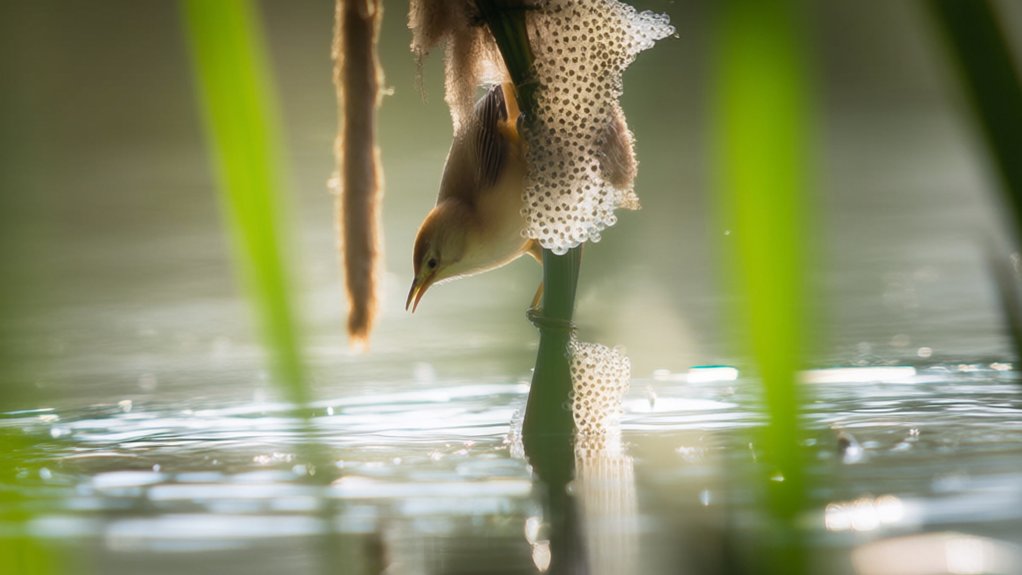
Yes, birds can carry fish eggs between ponds by having sticky eggs adhere to their feathers, feet, or beaks during feeding. Some species even swallow eggs, which can survive gut passage and hatch later. Waterfowl like Mallards are effective dispersers, traveling miles or more, influencing fish colonization and gene flow.
However, scientific proof is limited, and egg survival rates remain low. Exploring these mechanisms reveals important insights into aquatic ecosystems and species spread. It’s pretty fascinating how birds might play a role in moving fish populations around without us even noticing.
Mechanisms Birds Use to Disperse Fish Eggs Between Ponds
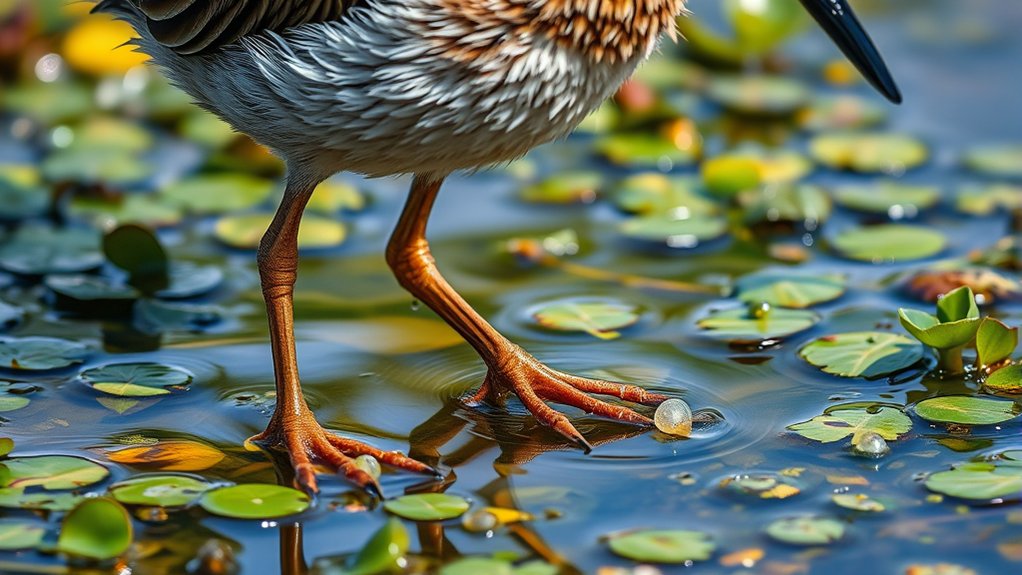
Although fish eggs are aquatic by nature, birds play a surprisingly effective role in dispersing them between isolated ponds. You might observe that sticky fish eggs temporarily adhere to a bird’s feathers, feet, or beak. This adhesion allows birds, especially waterfowl, to transport eggs during flight across distances ranging from a few miles to hundreds.
You’ll find that the eggs’ survival depends on their resilience to handling, varying environmental conditions, and even digestion if ingested. Some species’ eggs, such as carp, have been shown to endure passage through a bird’s digestive system, offering another dispersal route. It’s pretty fascinating how these eggs can survive such a journey!
The efficiency of this natural transport hinges on the bird’s behavior, including habitat use and movement patterns. These factors ultimately dictate the likelihood of eggs reaching new, isolated aquatic habitats. So, next time you see a duck or a heron, remember—they might just be carrying more than you think!
Why Some Fish Eggs Are More Likely to Stick to Birds

You’ll notice that fish eggs with sticky surfaces—like those covered in gelatinous layers—tend to cling more easily to bird feathers and feet. This stickiness happens because of certain chemical and textural traits that help the eggs stick during quick contact with waterfowl.
When you think about how these egg features work with bird plumage, it becomes clear why some species’ eggs are better at hitching a ride.
Egg Adhesion Properties
How do some fish eggs manage to cling so effectively to bird feathers or feet during transportation? The key lies in their adhesion properties. Species like carp produce eggs coated with mucilaginous substances, making them naturally sticky. This mucilage enhances the egg’s ability to attach firmly to waterfowl surfaces.
Egg adhesion varies widely among fish species, influencing how easily eggs can hitch a ride. Environmental conditions, such as water temperature and the egg’s maturity stage, also affect stickiness. For example, warmer waters or less mature eggs mightn’t stick as well.
This adhesive quality increases survival chances during flight, helping eggs remain attached despite movement and air currents. Understanding these properties clarifies why certain fish eggs have greater potential for dispersal via birds. It highlights an intricate ecological interaction between fish and waterfowl.
Bird Feather Interaction
When fish eggs come into contact with bird feathers, their chances of sticking depend on both the egg’s physical and chemical properties and the feather’s structure. Eggs with a sticky, mucilaginous, or gelatinous coating cling more effectively to feathers, which increases the likelihood they’ll get transported.
The chemical makeup and surface texture of these eggs make them more adhesive, especially when they’re smaller and stickier.
On the bird’s side, feathers that have rough textures or barbs offer more surface area and grip, making it easier for eggs to attach. Smooth feathers, on the other hand, are less likely to hold onto eggs.
Understanding how this interaction works helps explain why some fish eggs hitch rides on waterfowl. This natural hitchhiking contributes to the spread of fish between ponds when birds take flight.
How Fish Eggs Survive Passing Through Bird Digestion
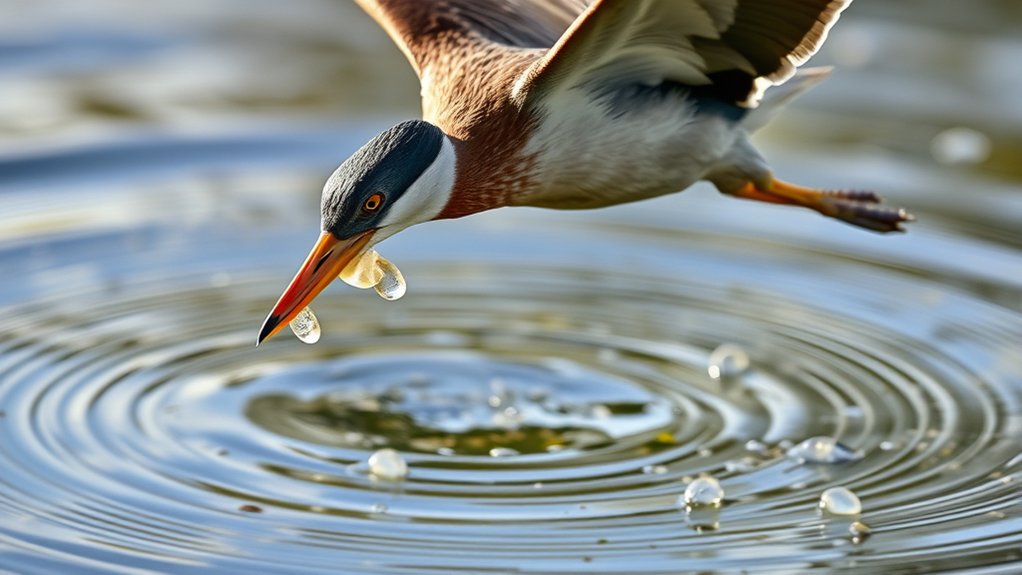
Although the digestive system of Mallards is designed to break down organic material efficiently, some fish eggs can survive the journey through their guts intact. Studies have recovered up to 0.2% of fed fish eggs whole after passage, with experiments confirming that some eggs remain viable, evidenced by hatchlings emerging post-digestion.
This survival hinges on the protective outer layers of the eggs, which resist the acidic and enzymatic conditions inside the bird’s gut. Importantly, embryos inside these surviving eggs retain viability, meaning digestion doesn’t necessarily destroy their potential for development.
Although survival rates are low, this process demonstrates a plausible natural dispersal mechanism. When you consider how resilient these eggs are, it’s clear that digestion doesn’t guarantee destruction. This allows fish eggs to potentially colonize new habitats via bird movement.
Most Effective Bird Species for Dispersing Fish Eggs
Since birds must come into direct contact with fish eggs to disperse them, species that feed along shallow water edges play an essential role in this process. Ducks like Mallards, which forage in shallow waters, frequently encounter fish eggs during feeding, increasing their potential as dispersers.
Birds feeding along shallow water edges, like Mallards, play a key role in dispersing fish eggs.
Their dabbling behavior allows them to pick up eggs stuck to substrates or floating near the surface.
Larger waterfowl that feed on or near water surfaces are more likely to transport eggs due to their size and feeding habits. However, scientific evidence directly confirming which species effectively disperse viable fish eggs remains limited.
Still, you can reasonably expect dabbling ducks and other water-edge foragers to be the primary candidates for this ecological role in connecting aquatic habitats.
How Far Birds Disperse Fish Eggs During Migration and Travel
Birds that forage along water edges not only pick up fish eggs but also move across significant distances during daily activities and seasonal migrations. You can observe waterfowl traveling up to 15 miles daily and migrating hundreds of miles, potentially dispersing fish eggs far beyond their original habitat.
Fish eggs may survive passage through the digestive tract or remain attached to feathers and feet, allowing for dispersal across diverse water bodies. The distance that eggs travel depends on bird movement, feeding behavior, and egg resilience.
| Bird Movement Type | Distance Range | Egg Dispersal Method |
|---|---|---|
| Daily Foraging | Up to 15 miles | Ingested or adherent eggs |
| Seasonal Migration | Hundreds of miles | Ingested and external |
| Local Habitat Shifts | Few miles | External attachment |
| Random Flights | Variable | Mixed methods |
How Bird-Dispersed Fish Eggs Help Colonize New Waterbodies
When waterfowl like Mallards travel between habitats, they inadvertently transport fish eggs that survive digestion or cling to their bodies. This enables these eggs to establish populations in new or isolated waterbodies.
Studies have shown that Mallards can excrete intact fish eggs capable of hatching, which confirms survival through the digestive tract.
Research reveals Mallards excrete viable fish eggs, proving survival through their digestive systems.
Their extensive daily movements and migratory routes help spread these eggs over considerable distances. This connects aquatic systems that would otherwise stay isolated.
Even a small fraction of viable eggs reaching a new habitat can trigger colonization.
That colonization promotes genetic exchange and boosts biodiversity across waterbodies. By transporting fish eggs, these birds act as natural vectors, expanding fish distribution beyond traditional limits and helping ecosystems stay resilient.
Understanding this mechanism really highlights how avian behavior and aquatic colonization are connected.
Risks of Bird-Spread Invasive Fish Species
Although waterfowl like Mallards can transport fish eggs between habitats, the role they play in spreading invasive fish species remains uncertain. You should know that the survival rate of fish eggs passing through bird digestive systems is extremely low. About 0.2% remain intact after digestion.
Despite this, certain invasive species, such as Prussian carp and asexual reproducers, pose heightened risks. Even a few viable eggs can establish new populations.
However, due to limited and inconclusive research, scientists have yet to confirm bird-mediated dispersal as a significant pathway for invasive fish spread. So, while the risk exists, especially with resilient invasive species, it remains a possible but unverified mechanism.
More detailed study is needed to accurately gauge ecological impacts.
Scientific Evidence on Bird-Mediated Fish Egg Dispersal
You won’t really find solid scientific evidence showing that birds actively disperse viable fish eggs between water bodies. In fact, experiments rarely manage to recover intact eggs from bird feces, which makes the idea that birds are significant vectors pretty questionable.
Evidence Supporting Egg Survival
Since fish eggs face harsh conditions during digestion, you might expect none to survive passage through bird guts. However, scientific studies reveal that about 0.2% of fish eggs remain intact after digestion.
Experiments with Mallards showed that some ingested eggs not only survive but hatch into viable embryos afterward.
Species like Prussian and common carp have had eggs recovered and successfully hatched after being fed to waterfowl in controlled settings. Although survival rates are low, they’re significant enough to suggest potential for dispersal over long distances.
These findings challenge assumptions about egg fragility and provide direct empirical evidence supporting the possibility of bird-mediated fish egg dispersal. It’s a fascinating, if limited, ecological mechanism for aquatic species spread.
Challenges In Confirming Dispersal
While the idea that water birds disperse fish eggs between ponds has gained traction, no scientific studies have definitively confirmed this mechanism. You’ll find that a systematic review by the University of Basel found no concrete evidence supporting bird-mediated fish egg dispersal.
Although many experts consider it plausible, empirical data demonstrating fish eggs’ survival through transport and successful establishment in new habitats is lacking.
Research on aquatic invertebrates shows some bird involvement in dispersal, but fish eggs remain unproven. This absence of direct evidence challenges the assumption that waterfowl serve as significant vectors for fish eggs across isolated ponds.
As a result, confirming this dispersal pathway scientifically remains a complex challenge, requiring precise observation and experimental validation.
Importance Of Further Research
Despite the lack of definitive proof, the hypothesis that water birds disperse fish eggs remains a significant topic for scientific inquiry. You’ll find that understanding this process is vital for ecological management and conservation strategies.
Current research highlights gaps and emphasizes the need for focused studies to confirm or refute bird-mediated dispersal.
Consider these key points:
- A University of Basel review found no direct evidence supporting fish egg transport by birds.
- Experts agree the idea is plausible but lacks empirical confirmation.
- Proving this dispersal method would reshape views on fish population dynamics.
- Clarifying these mechanisms aids invasive species control and species reintroduction efforts.
You’ll see that further research will refine ecological models and influence conservation policies.
Using Bird Dispersal Knowledge to Manage Fish Populations
When you grasp how birds disperse fish eggs, you can develop more effective strategies to manage fish populations across different water bodies. Understanding that species like Mallards survive digesting fish eggs and transport them over long distances allows you to predict and influence fish distribution patterns.
Recognizing how birds like Mallards disperse fish eggs helps predict and manage fish populations across ecosystems.
You can modify habitats to encourage native fish spread or restrict invasive species by controlling waterfowl access to sensitive ecosystems.
Incorporating bird-mediated egg dispersal data into fish population models improves your ability to forecast invasive species expansion and tailor interventions accordingly. Managing waterfowl behavior and habitats becomes a vital tool in preventing unwanted fish introductions, ensuring ecological balance.
This approach enables targeted, science-based management that integrates avian behavior with aquatic conservation goals.
Frequently Asked Questions
Can Fish Eggs Survive Out of Water During Bird Transport?
Yes, fish eggs can survive out of water during bird transport, especially sticky or resilient types. You’ll find that some eggs withstand brief drying and digestion. This means viable eggs can hatch after passing through birds’ systems.
It’s pretty fascinating how nature works, right? Birds unintentionally help spread fish eggs to new places just by carrying them around. So, next time you see a bird near water, remember it might be moving more than just itself!
Do Birds Prefer Ponds With Certain Fish Species for Egg Dispersal?
Do you think birds choose ponds randomly? You’ll notice they prefer ponds with sticky-egg species like carp since those eggs cling to feathers, increasing dispersal chances.
How Do Environmental Factors Affect Bird-Mediated Fish Egg Movement?
You’ll find that warm, humid conditions help fish eggs survive on birds by preventing desiccation. At the same time, heavy rain plays a big role in helping eggs detach and spread out.
Temperature extremes also matter a lot. Plus, aquatic vegetation near ponds can strongly influence how well the eggs stay viable and get successfully deposited.
All these factors together shape how fish eggs move around thanks to birds. It’s pretty interesting how nature works like that!
Are There Seasonal Patterns in Bird Fish Egg Dispersal Behavior?
Ever wonder why spring feels so alive with movement? Yes, seasonal patterns exist. Birds disperse fish eggs mostly during breeding and migration seasons when they’re active and ponds are nearby.
This timing optimizes egg survival and dispersal chances considerably. It’s like nature’s way of making sure the next generation gets the best start. Cool, right?
Can Fish Egg Dispersal by Birds Impact Local Fishing Regulations?
Yes, fish egg dispersal by birds can impact local fishing regulations. This might lead to stricter controls on waterfowl movement to prevent the spread of invasive species.
It’s all about making sure management practices protect native fish populations. Plus, maintaining ecological balance in sensitive water bodies is a big priority. So, regulations may change to address these concerns more effectively.
Conclusion
Think of birds as nature’s diligent couriers, ferrying fish eggs like fragile seeds between watery domains. Just as a single seed can spark a thriving forest, a tiny egg carried by a bird can ignite new aquatic life far from its origin.
Understanding this subtle, airborne journey reveals the delicate balance of ecosystems. It reminds you how interconnected life truly is. Even the smallest travelers play a vital role in shaping diverse, resilient habitats.