
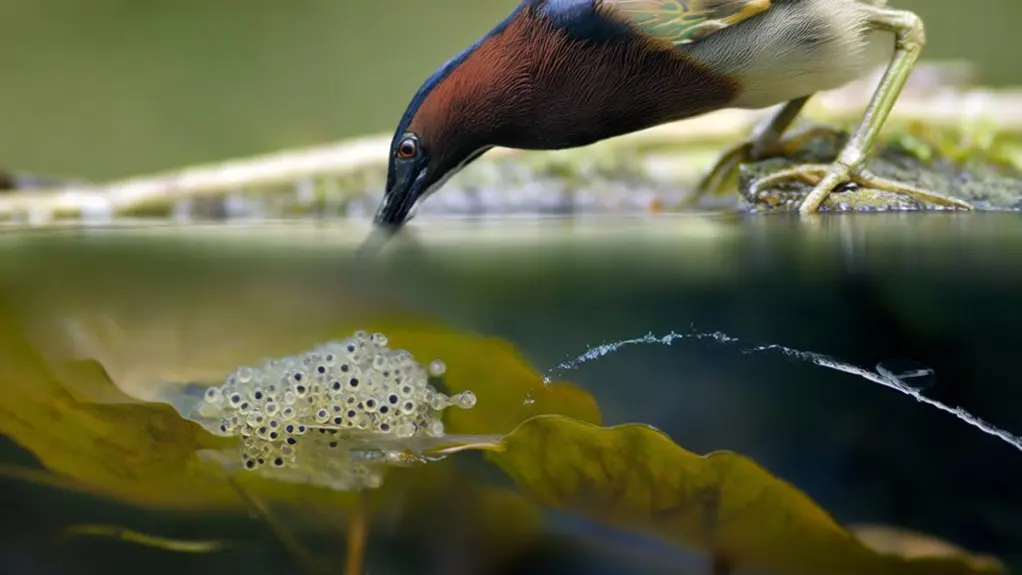
Yes, waterfowl actively consume fish eggs while feeding, and some eggs can survive the bird’s digestive system. Studies show about 0.2% of ingested eggs remain viable, with a few even hatching after being excreted. Factors like gut retention time and egg membrane strength influence survival.
Birds can disperse viable eggs over long distances during flight, which helps fish colonize and spread to new areas. It’s pretty fascinating how these birds play a role in moving aquatic species around. Understanding this process reveals some surprising ecological dynamics that shape how fish populations are distributed and evolve.
How Do Fish Eggs Get Inside Waterfowl?
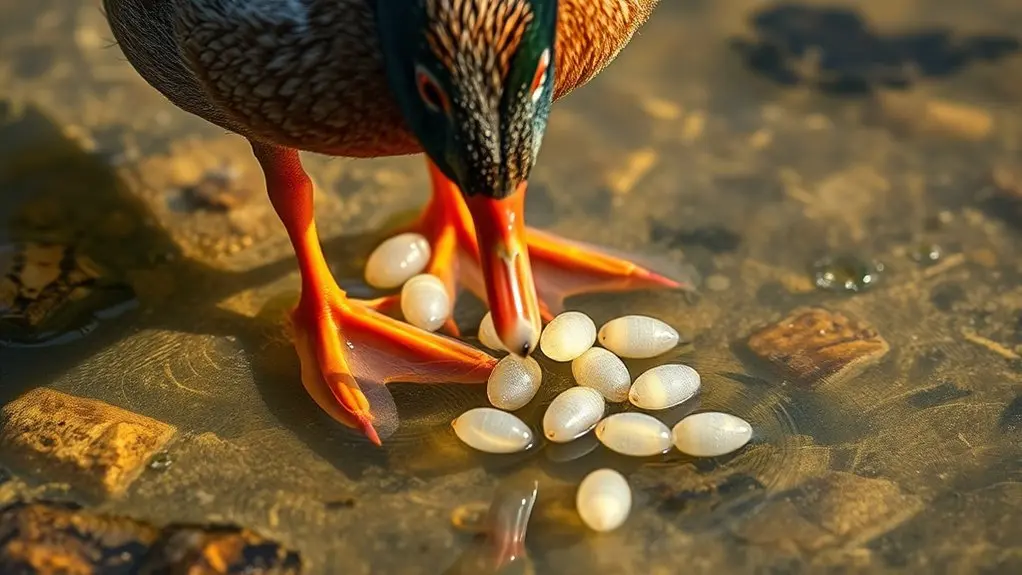
Although it may seem unlikely at first, fish eggs enter waterfowl primarily when these birds consume fish or forage in environments rich with fish eggs. During bird migration, waterfowl often exploit diverse aquatic habitats where eggs are abundant, increasing the likelihood of egg predation.
As you watch these birds feed, you’d notice them swallowing fish eggs whole while foraging. This ingestion happens because fish eggs are accessible and nutritionally valuable. Egg predation by waterfowl plays a role in aquatic ecosystems, affecting fish population dynamics.
The eggs’ entry into the birds’ digestive system results from their feeding behavior rather than accidental ingestion. So, understanding how fish eggs get inside waterfowl is essential to studying dispersal mechanisms and ecological interactions during bird migration and feeding activities.
Can Fish Eggs Survive Passage Through a Bird’s Digestive System?
You might think that fish eggs wouldn’t stand a chance going through a digestive system, right? Surprisingly, studies have found that a small number of these eggs actually survive after passing through a bird’s gut.
For example, experiments with mallard ducks show that about 0.2% of the eggs make it through unharmed. Even more interesting, some of those eggs hatch after digestion!
This really suggests that birds could play a role in spreading fish eggs internally.
Egg Viability Through Digestion
When fish eggs pass through a bird’s digestive system, a small percentage can survive the harsh conditions of mechanical pressure and enzymatic breakdown. You should understand that egg viability depends on several factors during digestion.
Fish eggs endure mechanical pressure from muscular contractions and exposure to digestive enzymes that break down organic material. They also face physical pummelling within the gut environment. The duration of gut passage influences how much damage they get.
Research shows that despite these challenges, some eggs remain intact and viable after digestion. In controlled studies, a minimal fraction of ingested eggs survive and can hatch hours later. This indicates they’re pretty resilient to digestive enzymes.
This survival suggests a natural dispersal mechanism where birds help fish colonize isolated habitats by transporting viable eggs internally. Pretty cool, right?
Experimental Survival Rates
How resilient are fish eggs when passing through a bird’s digestive system? Experiments with captive mallard ducks reveal about 75% of fish eggs recovered from feces remain viable, with some hatching successfully. This shows fish embryos can withstand squeezing, pummelling, and digestive enzymes during gut transit.
Although only 0.2% of eggs typically survive, the sheer quantity consumed by waterbirds makes this dispersal ecologically meaningful. Feather adaptation helps birds forage efficiently, which increases egg ingestion. Plus, migratory patterns allow long-distance egg transport across habitats.
These findings support internal dispersal of fish eggs via birds. It highlights a unique ecological interaction where avian digestion doesn’t fully stop fish embryo survival. This gives us insight into how aquatic species distribution is helped by bird behavior and physiology.
What Experiments Prove Fish Eggs Survive Gut Passage?
Although it was previously uncertain whether soft-membraned fish eggs could survive digestive transit, biologist Ádám Lovas-Kiss and colleagues conducted controlled experiments feeding captive mallard ducks around 500 fish eggs from common carp and Prussian carp. Their results provided direct evidence of egg survival despite gut passage, challenging assumptions about egg predation and nest contamination risks.
Key findings include the recovery of 18 eggs from feces, with 12 viable and 3 hatching successfully. Egg passage times were mostly within 1 hour, though some took up to 6 hours. This implies potential dispersal distances up to 360 km.
Failure to hatch was primarily linked to fungal infections from experimental conditions. They demonstrated that embryonated soft-membraned fish eggs endure digestive processes intact.
These experiments confirm that birds can contribute to fish egg dispersal by surviving gut passage. This finding influences how we understand egg predation and contamination in ecological contexts.
What Factors Affect Fish Egg Survival During Bird Digestion?
The survival of fish eggs during bird digestion depends on several physical and biological factors that challenge their integrity. You have to think about the egg membrane’s (chorion) resistance because it plays a vital role in protecting the embryo against mechanical stresses like squeezing and pummelling.
Digestive enzymes are another threat since they break down organic material, so being durable against these enzymes is really important. The developmental stage at ingestion also matters. More mature embryos might be better at withstanding digestion.
Fungal infections can reduce egg viability after gut passage, and these often come from handling or experimental conditions. Also, the timing of egg passage usually happens within the first hour and affects survival chances. The longer eggs are exposed to digestive processes, the less likely they’re to stay intact and viable.
How Far Can Birds Disperse Fish Eggs by Flying?
Because fish eggs can survive passage through bird digestive systems, birds play a big role in spreading them over long distances. How far the eggs go depends on things like the birds’ migratory patterns, how fast they fly, and how long the eggs stay inside their digestive tract.
Feather coloration might also have an indirect effect by influencing which bird species survive and their migration routes.
Here are some key points to keep in mind: fish eggs usually exit within about 1 hour, which means they can be dispersed roughly 60 km.
If the eggs stay inside for 4 to 6 hours, they can be carried as far as 360 km. Ducks, for example, have a digestive passage time that ranges between 1 and 6 hours.
So, the distance the eggs travel really depends on how the birds move and when they eat relative to when the fish spawn.
Understanding these variables helps us see how birds contribute to connecting fish populations across different landscapes.
How Does Bird Dispersal Help Invasive Fish Spread?
When birds consume fish eggs and transport them to new habitats, they directly help spread invasive fish species. By eating the eggs, birds allow some of them to survive the trip through their digestive system. About 0.2% of the eggs make it through and can end up in isolated water bodies up to 60 km away within just a few hours.
This kind of dispersal helps invasive fish like carp colonize new environments really fast. Moving eggs via birds also helps the eggs avoid predators by shifting them from risky areas to safer spots.
Plus, birds transfer nutrients between ecosystems through their droppings, which can improve habitat conditions that favor invasive fish.
How Does This Discovery Change Our Understanding of Fish Colonization by Birds?
So, now you see that birds carrying fish eggs inside them help fish get past geographic barriers we used to think were impossible to cross. This means fish can show up in far-off lakes and ponds without anyone physically moving their eggs.
It’s pretty cool because realizing this internal way of dispersal changes how we think about fish spreading out and how ecosystems develop over time.
It gives us a whole new perspective on fish invasions and biodiversity patterns.
Bird-Mediated Egg Dispersal
How do fish manage to colonize remote lakes and ponds separated by vast land barriers? Bird-mediated egg dispersal reveals a vital vector: fish eggs survive gut passage within birds. This discovery reshapes your understanding of fish colonization by showing birds as active dispersal agents.
Feather adaptations and wingspan help birds travel long distances, which means viable fish eggs can disperse across hundreds of kilometers. It’s pretty fascinating when you think about it.
Here are some key insights: up to 12 viable fish eggs can pass through bird digestive systems intact. Some eggs even hatch successfully after going through a bird’s gut.
Waterfowl movements explain why fish show up in isolated ecosystems. Plus, this mechanism plays a role in both native fish distribution and the spread of invasive species.
Overcoming Isolation Barriers
Since fish eggs can survive passage through bird digestive systems, this discovery redefines the mechanisms behind fish colonization of isolated aquatic habitats. You now understand that bird migration actively transports viable eggs internally, overcoming geographic isolation that passive dispersal could not.
This challenges previous views that limited fish spread to external egg attachment. It reveals that despite low survival rates (around 0.2%), the sheer quantity of eggs and bird movement can effectively overcome egg predation and isolation barriers. It’s pretty fascinating how nature finds a way, isn’t it?
| Factor | Previous Assumption | New Understanding |
|---|---|---|
| Dispersal Method | External attachment | Internal gut passage |
| Survival Rate | Negligible | Low but significant (~0.2%) |
| Role of Birds | Passive carriers | Active vectors via migration |
| Isolation Barrier | High | Reduced by internal dispersal |
| Egg Predation | Major limitation | Mitigated by gut passage protection |
Impacts on Fish Distribution
Building on the understanding that bird migration enables internal transport of viable fish eggs, this discovery profoundly reshapes the perspective on fish distribution patterns.
You now see that feather adaptations and migratory patterns facilitate the dispersal of fish eggs internally, across vast distances.
This mechanism explains rapid colonization of isolated water bodies by fish via gut passage. It also demonstrates survival rates of up to 75% for fish eggs transported internally.
Plus, it highlights bird-mediated dispersal as a significant vector alongside external means.
It even reveals the role of waterfowl in spreading invasive species and shaping biodiversity.
This evidence fundamentally shifts your view of fish colonization, emphasizing birds as active agents in freshwater ecosystems.
It also changes assumptions about how fish populations establish and expand across fragmented habitats.
Frequently Asked Questions
Which Bird Species Are Most Likely to Interact With Fish Eggs?
You’ll find dabbling ducks, gulls, and shorebirds most likely interacting with fish eggs. Bird digestion plays a role in how these eggs get dispersed. It’s pretty interesting how these birds impact fish populations just by their feeding habits.
Swans and geese also contribute to this process. Because they move around a lot, they help transport fish eggs across different ecosystems. This mobility means fish eggs can spread much wider than you might expect.
How Do Fish Eggs Typically Disperse Without Bird Involvement?
You won’t find fish eggs hitching rides through bird digestion. Instead, they rely on gentle water currents and sticky surfaces for egg dispersal. The eggs either drift along or cling to substrates.
This method ensures a localized spread without any involvement from birds. So, fish eggs usually don’t travel long distances. It’s a simple, natural way to keep their populations close to home.
Can Fish Eggs Survive in Other Animals Besides Birds?
You won’t find strong evidence that fish eggs survive avian digestion in animals besides birds. Egg buoyancy and resistant chorions help survival in birds, but mammals or reptiles rarely support viable egg passage through their digestive systems.
In other words, fish eggs are pretty specialized for getting through bird stomachs. When it comes to mammals or reptiles, it’s a different story. Their digestive systems usually break down the eggs before they can survive. So, it’s not common to see fish eggs making it through anything other than birds.
What Environmental Conditions Support Fish Egg Survival Outside Water?
You’ll find fish eggs survive best outside water when aquatic plants provide shelter. Stable water chemistry helps, too, keeping pH and oxygen levels balanced.
It’s also important that temperatures stay steady. Too much sunlight can cause problems, so minimal exposure helps prevent drying out and fungal infections.
Basically, a calm, protected environment with the right conditions is key for those eggs to thrive.
Are There Alternative Methods for Fish Colonization in Isolated Waters?
You’ll find avian dispersal isn’t the sole player; alternative methods like water currents, human activity, and resistant eggs help fish bypass egg predation.
These methods enable colonization of isolated waters through natural and anthropogenic pathways. It’s pretty interesting how fish can use different routes to spread.
Conclusion
So, next time you see a bird take flight, imagine it as a feathery fish egg delivery service, complete with digestive obstacle courses. You might think, “No way eggs survive that gut gauntlet!” Yet, science shows some do, hitching rides inside birds to colonize new waters.
This unexpected poop-powered dispersal rewrites fish migration rules. It’s proof that nature’s mailing system is messier, odder, and far more efficient than you ever guessed.