

You can’t take birds to space because their flight depends entirely on Earth’s atmosphere, gravity, and oxygen availability. Their hollow bones, feather structure, and muscle coordination rely on air currents and pressure to produce lift. In space’s vacuum and microgravity, feathers lose flexibility, respiratory systems fail, and flight mechanics collapse.
Birds lack biological adaptations for radiation and environmental extremes encountered beyond Earth. So, they just aren’t built to handle those harsh conditions. Explore further to understand how these limitations shape their survival and mobility in space environments.
Why Are Birds Built to Fly in Earth’s Atmosphere?
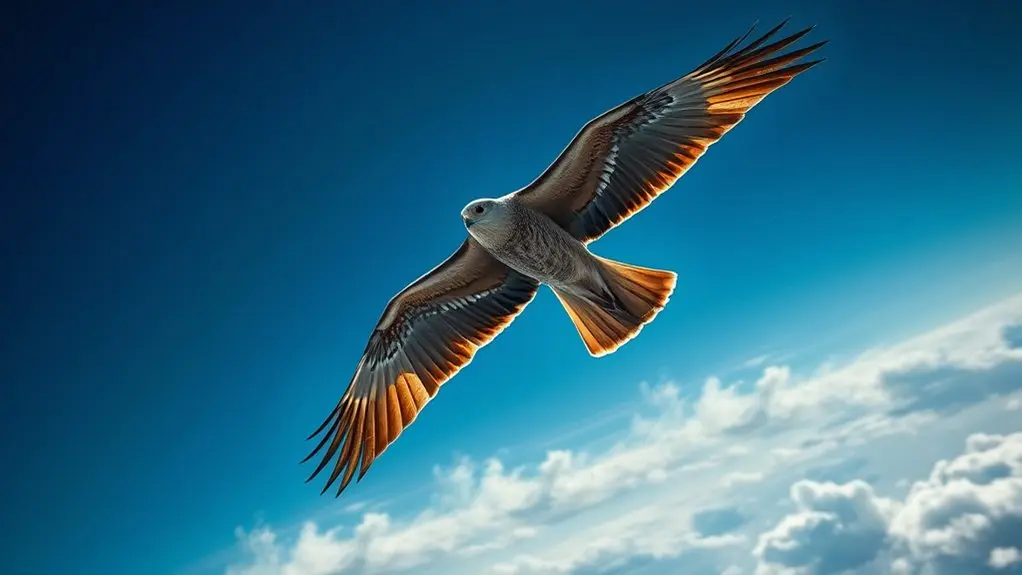
Because birds have evolved to thrive within Earth’s atmosphere, their anatomy is finely tuned for flight under these specific conditions. You’ll notice their wing design maximizes lift and propulsion by balancing surface area with aerodynamic efficiency. The flexibility of their feathers plays a vital role, allowing subtle adjustments to airflow and reducing drag.
Their lightweight, hollow bones and powerful flight muscles complement these features, enabling sustained flight. Feathers provide a dynamic surface that adapts to changing air pressures, enhancing maneuverability.
These adaptations depend on Earth’s atmospheric density and oxygen availability, which support metabolic energy demands during flight.
In short, you can see that birds’ structural elements, from feather flexibility to wing design, are precisely optimized for Earth’s atmospheric conditions. This ensures effective flight performance every time.
Why Can’t Birds Fly to Space?
Although birds have amazing adaptations for flight within Earth’s atmosphere, these features just don’t work beyond it. If you think about how birds migrate and how flexible their feathers are, you’ll see that they rely on Earth’s air currents and oxygen. Both of these are missing in space.
Their respiratory and circulatory systems are designed for gravity and atmospheric pressure, so they can’t function properly in zero gravity or a vacuum. You also have to consider a few things:
Lack of atmospheric pressure makes their bodily systems malfunction. Without oxygen, their metabolism stops, which means no energy for flight. Zero gravity messes with muscle coordination, which is essential for moving their wings.
Plus, the vacuum of space makes their feathers lose the flexibility they need for aerodynamic control.
How Do Birds’ Bodies Differ From Space-Adapted Organisms?
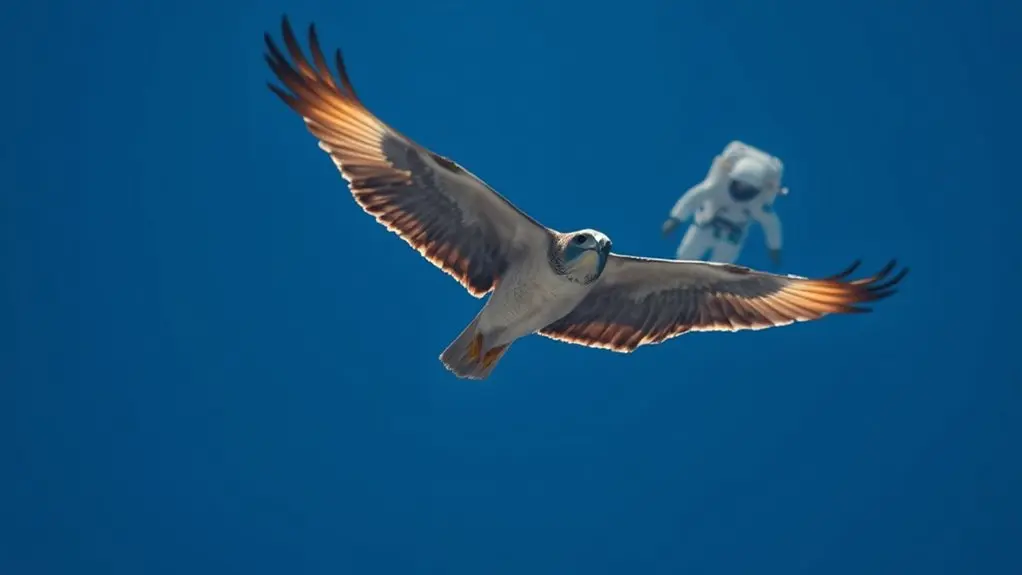
You’ll notice that birds have lightweight, hollow bones and feathered bodies that are perfect for flying through the air.
On the other hand, space-adapted organisms tend to have dense structures and surfaces that resist radiation. Their muscles and metabolisms are also quite different.
Birds are built for quick bursts of energy needed in the atmosphere, while space creatures are designed to survive in microgravity and low-oxygen environments.
When you understand these differences in structure and function, it really shows why flying biologically in space is such a challenge.
Structural Adaptations Comparison
How exactly do birds’ structural adaptations contrast with those of space-adapted organisms? Birds have lightweight, hollow bones with low bone density, which helps reduce body weight and makes powered flight possible.
In contrast, space-adapted organisms have denser, more protective skeletal structures to handle microgravity and radiation.
Feather insulation gives birds aerodynamic stability and helps with thermal regulation. Space organisms don’t have feathers, so they rely on other ways to protect themselves.
When it comes to muscles, birds have systems focused on wing flapping strength, while space dwellers have muscles adapted for moving around in microgravity.
- Feather insulation supports temperature control and flight efficiency
- Hollow bones minimize weight for atmospheric lift
- Dense, protective skeletons shield against space hazards
- Specialized muscles align with environmental demands
This clear difference in structure shows why birds’ bodies just aren’t built for space travel.
Biological Flight Limitations
Because birds evolved specifically for atmospheric flight, their biological systems impose strict limitations when considered in the context of space environments. You’ll notice that avian migration relies heavily on lightweight, hollow bones optimized for lift and maneuverability within Earth’s gravity.
This is quite different from space-adapted organisms that have denser or specialized skeletal frameworks designed to withstand vacuum and radiation.
The powerful pectoral muscles birds use for wing flapping become nonfunctional in microgravity, so flight just isn’t possible up there.
Their respiratory and circulatory systems depend on gravity-driven oxygen exchange and blood flow, which don’t work efficiently in space.
Feather adaptation, essential for aerodynamic control and insulation during flight, doesn’t offer any advantage in the vacuum or zero-gravity of space.
Space Survival Mechanisms
Although birds have evolved remarkable adaptations for flight within Earth’s atmosphere, their biological design fundamentally lacks the mechanisms required for space survival. Bird flight depends on atmospheric adaptation, which space environments completely lack.
Unlike space-adapted organisms, birds can’t regulate metabolism or shield themselves from space radiation.
Think about these critical differences: hollow bones reduce weight for flight but fail under space’s extreme conditions. Their respiratory and circulatory systems rely on Earth’s gravity and oxygen, both absent in space.
Feathers and body structures optimize aerodynamic lift but offer no vacuum or radiation protection.
Also, birds lack cellular mechanisms to repair radiation damage or adapt to microgravity. These physiological constraints prevent birds from surviving outside our atmosphere.
It really shows the fundamental gap between Earth-bound avian biology and space survival mechanisms.
Can Birds Survive the Harsh Conditions of Space?
Even with advanced life support systems, birds can’t survive the vacuum, extreme temperatures, and microgravity of space unaided. Avian migration relies on Earth’s atmosphere and gravity, which are essential for flight biomechanics that govern wing movement and balance.
In space, the absence of air eliminates aerodynamic lift, making flight impossible. Microgravity disrupts feather alignment and vestibular function, which impairs balance and orientation—both critical for avian physiology.
Experiments reveal that while fertilized eggs may endure protected conditions, live birds require controlled environments with regulated oxygen, temperature, and pressure to maintain homeostasis. Without these, key biological processes fail, and survival is compromised.
How Does Human Technology Enable Space Travel?
When you look at how humans have conquered space travel, it’s clear that advanced technology plays a crucial role. Unlike birds, which rely on evolutionary traits adapted for Earth’s atmosphere, humans depend on engineered systems to overcome the physical and ecological impacts of space.
Rockets use controlled propulsion, exploiting Newton’s third law to escape gravity.
Spacecraft have advanced materials and precise navigation to operate in microgravity and sustain life beyond Earth. You should appreciate how reusable rockets reduce ecological impacts by minimizing waste.
Satellite technology also enhances navigation and communication.
Life-support systems help counteract microgravity’s effects.
Physics principles like thrust generation enable controlled flight.
Human technology’s precision and innovation make space travel possible, contrasting natural flight limitations and showcasing humanity’s unique approach.
What Have Space Experiments Revealed About Birds?
Human technology enables flight beyond Earth’s atmosphere, but understanding how natural flyers like birds respond to space conditions offers valuable insights. Space experiments reveal that fertilized bird eggs can survive microgravity, showing resilience in early development stages.
However, live birds can’t perform avian migration or sustained flight in space because there’s no atmospheric lift or gravity to support them. Instead, they rely on feather morphology for stabilization in microgravity, which highlights how important feathers are beyond just flight mechanics.
Birds subjected to space conditions need intensive care, including force-feeding, to keep up their physiological functions. These findings show that while avian life can endure initial space conditions, natural flight mechanisms—especially those involved in migration—don’t work without Earth’s atmospheric parameters.
It really emphasizes how crucial environmental factors are for birds to move around.
Frequently Asked Questions
Do Any Birds Migrate at Altitudes Close to Space?
You won’t find birds migrating near space altitudes because their wing adaptations optimize flight below 40,000 feet. Migration timing also aligns with atmospheric conditions unsuitable for near-space environments. This limits their maximum altitude well below space boundaries.
Basically, birds just aren’t built to handle the extreme conditions way up there. Their bodies and flight patterns work best closer to Earth’s surface where the air is thicker. So, flying near space is simply not on their radar.
Can Birds Sense Changes in Atmospheric Pressure During Flight?
Sure, you can trust that bird sensory systems excel at atmospheric detection. They actively analyze air pressure shifts, allowing them to adapt altitude and avoid hazards. This showcases a sophisticated, sensitive, and survival-driven response during flight navigation.
Birds are pretty amazing when it comes to sensing changes around them. Their ability to pick up on subtle shifts in pressure helps them stay safe and efficient while flying. It’s like having a built-in weather monitor that guides their every move.
How Do Birds Navigate During Long-Distance Flights?
You navigate bird migration by relying on flight navigation cues like Earth’s magnetic field detected through specialized receptors. Birds also use solar and stellar positioning to find their way.
This is all supported by an internal clock that helps synchronize timing and directional accuracy during long-distance flights. It’s pretty amazing how they combine these different signals to stay on course!
Have Birds Ever Been Accidentally Carried Into the Upper Atmosphere?
Yes, you’ve seen birds accidentally carried into the upper atmosphere, mainly vultures near 38,000 feet. Their bird flight mechanics and avian evolutionary history limit natural altitude, but rare incidents show they can reach extreme heights unintentionally.
It’s pretty fascinating, right? Usually, birds don’t fly that high on their own, but sometimes, strong winds or other factors can carry them way up there. So, while it’s not common, it does happen from time to time.
What Impact Does High Altitude Have on Bird Physiology?
High altitude reduces oxygen, challenging your bird wing adaptations and oxygen absorption mechanisms. You’ll notice decreased respiration efficiency, increased metabolic demand, and risk of hypoxia. This forces birds to rely on specialized physiological traits to sustain flight.
Birds have evolved amazing ways to cope with low oxygen environments. Their blood carries oxygen more efficiently, and their lungs are super adapted for maximum oxygen intake. It’s pretty cool how nature helps them keep flying high despite the tough conditions.
Conclusion
You’ve seen that birds are engineered specifically for Earth’s atmosphere, not the vacuum of space. Their bodies lack adaptations for zero gravity, radiation, and extreme temperatures. So, can birds truly survive or navigate space unaided? Clearly not.
Instead, human technology bridges this gap, enabling space travel and research. Understanding these limits highlights how specialized lifeforms are and why advanced engineering is essential for exploring beyond our planet.