

Yes, birds communicate using complex vocalizations like songs and calls that convey important information such as identity, danger, and social cues. You’ll find many species recognize and respond to each other’s alarm calls, which helps them survive better through cooperative vigilance.
This communication depends on a mix of innate signals and learned behaviors shaped by experience and environment. Understanding these dynamics shows how birds share detailed messages that are essential for managing threats and social interactions.
If you’re curious, explore further to uncover all the interesting nuances in their communication strategies. It’s pretty amazing how much they can convey without words!
What Roles Do Vocalizations Play in Bird Communication?
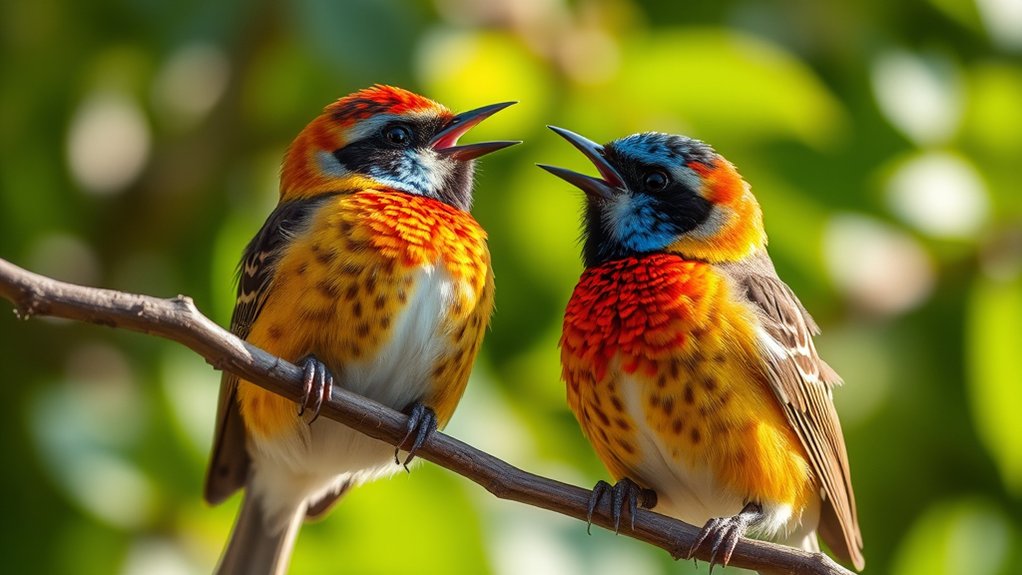
Although you mightn’t always notice, bird vocalizations play essential roles in their communication systems. You’ll find songs are often complex and species-specific, conveying information about individual identity, health, or reproductive status.
Bird songs, often intricate and unique, reveal vital details about identity, health, and mating readiness.
These songs primarily function to attract mates and defend territory.
On the other hand, calls tend to be simpler, serving immediate communication needs like alerting others to predators or maintaining flock cohesion. Different vocal signals can indicate the type and severity of threats, enabling birds to respond appropriately.
Environmental factors also influence vocal patterns. For example, birds in dense habitats may produce louder or more frequent calls to overcome background noise and distance.
Understanding these distinctions helps clarify how vocalizations support survival and social interactions within avian species.
Can Different Bird Species Understand Each Other’s Alarm Calls?
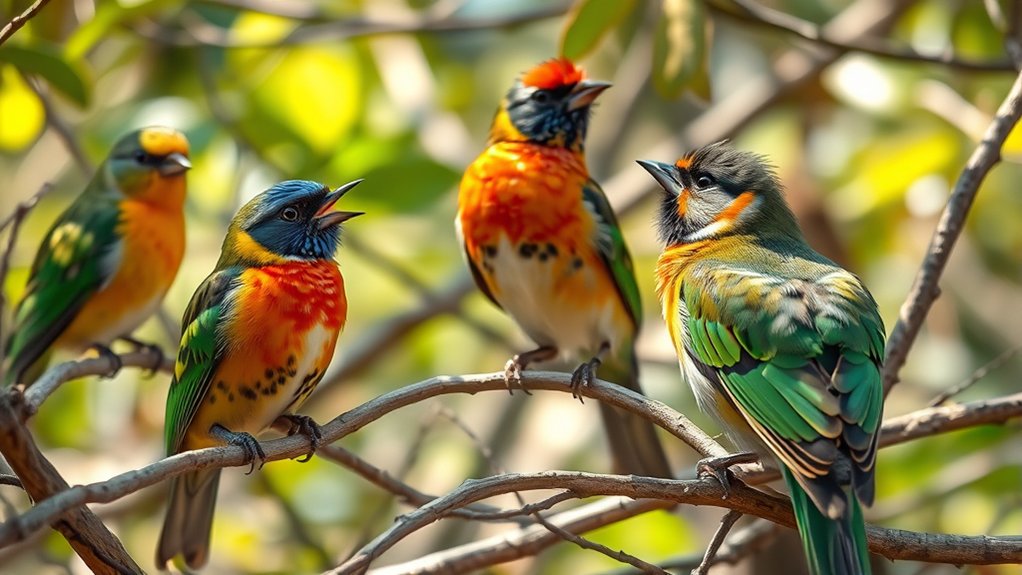
You’ll notice that many bird species, like black-capped chickadees and red-breasted nuthatches, actually recognize and respond to each other’s alarm calls. It’s a great example of cross-species communication in action.
Birds learn to interpret these calls through experience, which helps them figure out what kind of threat is nearby.
What’s even more fascinating is that some mammals, like squirrels and chipmunks, also pay attention to these alarm signals. Sometimes, they even mimic the calls to boost their own chances of survival.
It’s like a little neighborhood watch where different species look out for one another.
Cross-Species Alarm Recognition
When different bird species share habitats and face common predators, they often develop the ability to recognize and respond to each other’s alarm calls. You’ll see species like black-capped chickadees and red-breasted nuthatches reacting to shared raptor alarms, which shows some pretty cool cross-species understanding.
This alarm recognition alerts multiple species at the same time, helps differentiate threat types and severity, and increases the chances of survival for the whole group. It also encourages birds to stay more vigilant in their communities and even extends to some non-avian animals that mimic these calls.
It’s important to note that this ability is learned, not something birds are born with. This means they can adapt dynamically to their environment.
Learning Alarm Call Meanings
Building on the ability of different bird species to recognize shared alarm calls, researchers have investigated how birds actually learn to interpret these signals. You’ll find that this understanding is largely acquired through experience rather than innate knowledge.
Birds like black-capped chickadees and red-breasted nuthatches learn to associate specific alarm calls with certain predators, enabling accurate threat assessment.
Studies reveal that birds respond variably to different alarm calls, indicating they decode the level of danger conveyed by distinct acoustic features. This learned interpretation enhances survival by prompting appropriate defensive behaviors.
Remarkably, some non-avian animals, such as squirrels and chipmunks, also recognize and even mimic these alarm calls. This suggests a broader ecological network of communication centered on shared signals of danger.
Mammals Responding To Birds
Although alarm calls primarily help birds communicate within their own species, many mammals also respond to these signals. This shows a pretty interesting and complex exchange of information between different species.
You’ll find mammals like squirrels and chipmunks reacting to bird alarm calls by getting alert or even fleeing from predators.
Some mammals even go as far as mimicking these calls to warn others or confuse threats. Research shows that mammals eavesdrop on bird calls to figure out if there’s danger nearby.
What’s cool is that this recognition is often species-specific, like squirrels responding specifically to chickadee alarms.
The level of understanding varies, though, and it usually depends on learned recognition. So, mammals get better at recognizing these calls with experience.
- Squirrels freeze or flee upon hearing chickadee alarms
- Chipmunks increase vigilance after bird warnings
- Some mammals imitate bird calls to signal danger
- Mammals monitor interspecies calls to assess threats
- Recognition of calls often improves with experience
How Do Birds Learn to Recognize Alarm Calls From Other Species?

You learn that many birds pick up the ability to recognize alarm calls from other species by watching and hearing them over time, not just by instinct.
They pay attention to certain sounds, like pitch and frequency, to figure out how serious a threat is.
This kind of communication between different bird species helps them stay safe because they can react quickly to all kinds of dangers around them.
Learning Through Observation
How do birds learn to recognize alarm calls from other species? They primarily rely on observation, watching how others react to specific sounds. You’ll notice that young birds mimic adult responses and observe interspecies interactions to acquire this skill.
For example, superb fairy wrens can be trained to link unfamiliar alarm calls with predator models. This learning involves decoding subtle variations in pitch, tone, and call structure, which signal different threat levels. By doing so, birds gain an essential survival advantage through enhanced early predator detection.
You can imagine this process as:
- A juvenile bird attentively watching adult reactions
- Identifying changes in call pitch and tone
- Associating unfamiliar sounds with danger cues
- Observing interactions between multiple species
- Practicing learned responses during real threats
Decoding Alarm Call Signals
When birds encounter alarm calls from other species, they decode specific acoustic features such as pitch, tone, and urgency to figure out the level of threat. You’ll find that birds learn to recognize these calls mainly through observation and associative learning, not just because they’re born knowing them.
For example, superb fairy wrens can be trained to link unfamiliar alarm sounds with predator models. When they’re exposed to these sounds repeatedly, their ability to respond correctly gets sharper. So, both innate tendencies and learned experiences play a role in how they decode these signals.
| Acoustic Feature | Function |
|---|---|
| Pitch | Differentiates call types |
| Tone | Indicates emotional state |
| Urgency | Signals immediate threat level |
Cross-Species Communication Benefits
Building on the ways birds decode alarm calls within their own species, many also learn to recognize signals from other species through observation and repeated exposure. You can see this in species like black-capped chickadees and red-breasted nuthatches, which respond to each other’s alarms. This learning enhances survival by providing early predator warnings.
Birds focus on certain acoustic features to decode these calls, including pitch variations signaling urgency, call structure indicating predator type, repeated exposure strengthening recognition, associating sounds with visual predator cues, and cross-species alarm response increasing vigilance.
Experiments with superb fairy wrens reveal that pairing new alarm sounds with predator models trains them to identify unfamiliar threats. You can appreciate how this interspecies communication expands birds’ defensive strategies efficiently.
Why Are Alarm Calls Vital for Bird Survival?
Because alarm calls alert nearby birds to predators, they play a critical role in survival by increasing the chances of evasion. You’ll find that these calls are often species-specific, allowing you to identify different threats accurately. This specificity helps you assess the level of danger and respond accordingly.
Additionally, you can recognize alarm calls from other species, which helps with interspecies cooperation and boosts collective vigilance. When you hear an alarm call, your ability to respond quickly can mean the difference between escaping a predator or becoming prey.
Plus, eavesdropping on these calls helps you stay alert even if you’re not directly threatened.
How Do Other Animals Respond to Bird Alarm Calls?
Although bird alarm calls primarily serve avian communication, many non-avian animals like squirrels and chipmunks actively listen and respond to these signals by halting their activity and seeking cover. You’ll find these mammals often interpret the urgency and type of threat conveyed, adjusting their behavior accordingly.
Some even mimic titmouse alarm calls to warn conspecifics, demonstrating interspecies communication and deception.
When you observe their reactions, expect immediate cessation of movement, rapid scanning of surroundings, swift retreat to nearby cover, increased vigilance for predators, and mimicry of specific alarm calls.
This ability to eavesdrop on bird signals enhances their survival by providing early predator warnings, sometimes more effectively than their own species’ alerts. It really shows how complex and important cross-species communication is when it comes to avoiding predators.
What Other Vocalizations Help Birds Interact?
While alarm calls alert birds to danger, other vocalizations play essential roles in their daily interactions. You’ll find contact calls keep flocks together, while song and territorial calls assert dominance and defend resources. Some species, like cuckoos, mimic host begging cries to parasitize nests effectively.
Additionally, birds respond to specific sounds of other species to find food or avoid conflicts. Courtship songs or display calls are crucial for attracting mates and ensuring reproductive success.
| Vocalization Type | Purpose | Example Species |
|---|---|---|
| Contact Calls | Maintain group cohesion | Pigeons |
| Song | Establish territory | Songbirds |
| Begging Cry Mimicry | Parasitize nests | Cuckoos |
| Inter-species Calls | Locate food, avoid conflict | Mixed-species flocks |
| Courtship Songs | Attract mates | Nightingales |
Are Bird Communication Skills Innate or Learned?
When you observe bird communication, you’ll notice that some vocal responses appear innate, like basic alarm call recognition. Yet many complex signals develop through learning.
For example, superb fairy wrens don’t fully recognize alarm calls at birth; they acquire this skill through experience.
You’ll also find that young birds learn calls by mimicking adults. Birds adjust their responses after encountering novel sounds.
Species differ in the balance of innate versus learned communication.
Innate recognition often covers essential alerts like danger. Complex social signals usually require extensive learning.
This mix of hardwired traits and learned behaviors helps birds communicate effectively in their environments. So, while some skills come naturally, much of bird communication depends on learning and social interaction.
How Does the Environment Affect Bird Communication Methods?
Because different environments present unique challenges and opportunities, birds adapt their communication methods to optimize signal transmission and reception.
Birds tailor their communication strategies to suit the unique demands of their environments.
In dense forests, you’ll notice birds rely heavily on vocal communication since sound travels efficiently through thick foliage.
On the other hand, in open habitats like grasslands, birds use visual signals and flight patterns to communicate effectively over longer distances.
When you observe birds near noisy areas such as urban settings or waterfalls, you’ll find they adjust their calls by increasing volume or altering frequencies to overcome ambient noise.
Environmental factors like wind, rain, and physical obstacles can distort sounds, so birds modify their vocalizations for clarity.
Also, habitat structure influences signal complexity. Some species develop specialized calls tailored to their specific environments, making sure communication stays effective under varying conditions.
How Do Birds Use Calls to Share Food Information?
Although food sources can be unpredictable, birds use specific calls to communicate their presence and location to others efficiently. These vocalizations serve as essential tools for sharing food information, benefiting both individuals and groups.
When you observe birds, you might notice distinct calls indicating abundant or high-quality food. Different species can recognize these calls, which enables them to communicate across species. Birds also learn vocal patterns that improve group foraging success.
You may see reciprocal behaviors where birds respond to calls by joining food sites. This helps them find resources more easily, especially in dense or challenging environments. It’s pretty amazing how these calls work like nature’s little food alerts!
Frequently Asked Questions
Can Birds Communicate Emotions Like Happiness or Fear Through Body Language?
Yes, you can observe birds communicating emotions like happiness or fear through body language such as feather puffing, wing spreading, or crouching. These signals convey emotional states and alert other birds to potential threats or contentment.
It’s pretty fascinating how much you can tell just by watching their movements and posture. Birds don’t have vocal cords like we do, so body language is a big part of their communication. You start to notice patterns once you pay attention.
Do Birds Use Visual Signals as Much as Vocalizations for Communication?
You’ll find birds use visual signals as much as vocalizations, especially in dense habitats. Visual cues complement calls, conveying aggression, courtship, or alarm rapidly. Different species rely on these methods in varying ways.
Some go for elaborate displays, while others depend more on vocal communication. It really depends on the bird and the situation. So, both visual and vocal signals play key roles in how birds communicate.
How Do Birds Coordinate Complex Group Behaviors During Migration?
You navigate a symphony when coordinating group migration. Birds use vocal calls, visual signals, and environmental cues, led by experienced individuals, to synchronize flight.
They also alert each other to dangers and maintain cohesion across vast distances with precision. It’s pretty amazing how they pull it off together.
Are There Differences in Communication Methods Between Male and Female Birds?
Yes, you’ll notice males often use complex songs to attract mates and defend territory. Females, on the other hand, rely on subtler calls or visual signals. This reflects distinct communication roles shaped by reproductive behaviors and species-specific social dynamics.
It’s pretty interesting how these differences show up depending on the bird species and their environment. Each method plays a crucial role in their survival and reproduction.
Can Human-Made Noises Interfere With Bird Communication Effectiveness?
Yes, human-made noises interfere with bird communication by masking calls. You’ll notice birds shift frequencies or sing at different times.
But this adaptation can increase stress, reduce mating success, and elevate predation risks in noisy environments. It’s like they’re trying to talk over a really loud crowd, and it just wears them out.
Conclusion
You’ve seen how birds rely on vocalizations to warn, share, and survive, proving that communication is key in the wild. Just like the saying “a stitch in time saves nine,” timely alarm calls can mean the difference between life and death.
Whether these calls are innate or learned, they go beyond just one species. They shape complex interactions between birds and their environment.
Understanding this intricate system shows that bird communication isn’t just noise. It’s an essential, adaptive language that’s crucial for their survival.