

Yes, certain birds, especially homing pigeons, can deliver messages accurately over long distances. They navigate using the sun’s position, Earth’s magnetic field, and environmental cues like landmarks and scents. Historically, pigeons transmitted messages during wars and emergencies when other methods failed.
They proved reliable despite challenges like weather and terrain. Their unique navigation skills allowed communication across geographic barriers. It’s pretty amazing how they managed this.
Understanding how pigeons achieved this remarkable feat reveals a lot about early message delivery systems. Plus, it shows their lasting impact even today. Cool, right?
How Did Pigeon Post Begin and Why Was It Important?

Although modern communication relies heavily on electronic systems, pigeon post began as an ingenious method of message delivery thousands of years ago. You’ll find its origins with ancient Persians, who trained pigeons for communication across distances.
The Romans, including Julius Caesar, used these birds over 2,000 years ago, especially during military campaigns, to send critical messages rapidly.
The Greeks employed pigeons to announce Olympic victors to various cities, showing early practical uses in sports and politics.
During the 1870–1871 siege of Paris, pigeons transmitted official and private correspondence when telegraph lines failed. This really shows how reliable they were.
Throughout history, pigeon post proved indispensable in military contexts, maintaining communication when other systems were disrupted.
You can appreciate pigeon post as a precise, dependable method long before wireless technologies emerged. It’s pretty amazing how these birds played such a key role in communication back then.
How Do Pigeons Navigate for Pigeon Post?

You rely on pigeons’ ability to use several navigation tools to find their way. For example, they can use the sun’s position and even sense Earth’s magnetic field to guide their flight.
But that’s not all—they also pick up on environmental clues like landmarks and certain smells in the air. These help them zero in on their home location.
When you put all these factors together, it’s easier to see how pigeons manage to stay so accurate when delivering messages in pigeon post.
Navigation Mechanisms Explained
How exactly do homing pigeons find their way over long distances? You’ll notice they primarily use the sun’s position as a natural compass, adjusting their flight direction according to the time of day.
Additionally, pigeons appear to sense Earth’s magnetic field, which helps them determine their geographic location even when the sun isn’t visible.
Their keen sense of smell further aids navigation, allowing them to recognize specific odors linked to their home area.
Visual cues like landmarks, roads, and terrain features also play a critical role in orientation during flight.
If magnetic signals or familiar landmarks are disrupted, pigeons often struggle to navigate accurately.
This really highlights the delicate interplay of these mechanisms in their remarkable homing ability.
Environmental Influences On Flight
The navigation abilities of homing pigeons rely heavily on interpreting environmental signals that guide their flight paths. You’ll see that pigeons integrate multiple cues to find their way home accurately. They primarily rely on the sun’s position, adjusting their direction based on the time of day.
Additionally, they detect Earth’s magnetic field variations, which helps maintain orientation even under cloudy skies. Environmental scents and low-frequency sounds provide olfactory and auditory landmarks, especially over familiar terrain. Visual landmarks like roads, rivers, and buildings further refine their route.
Key environmental influences include:
- Solar compass for directional guidance.
- Magnetic field detection for orientation.
- Olfactory cues aiding terrain recognition.
- Visual landmarks supporting spatial navigation.
Disruptions to these cues can impair their performance profoundly. So, when any of these signals get messed up, pigeons might really struggle to find their way.
How Were Pigeons Used in Wartime Communication?
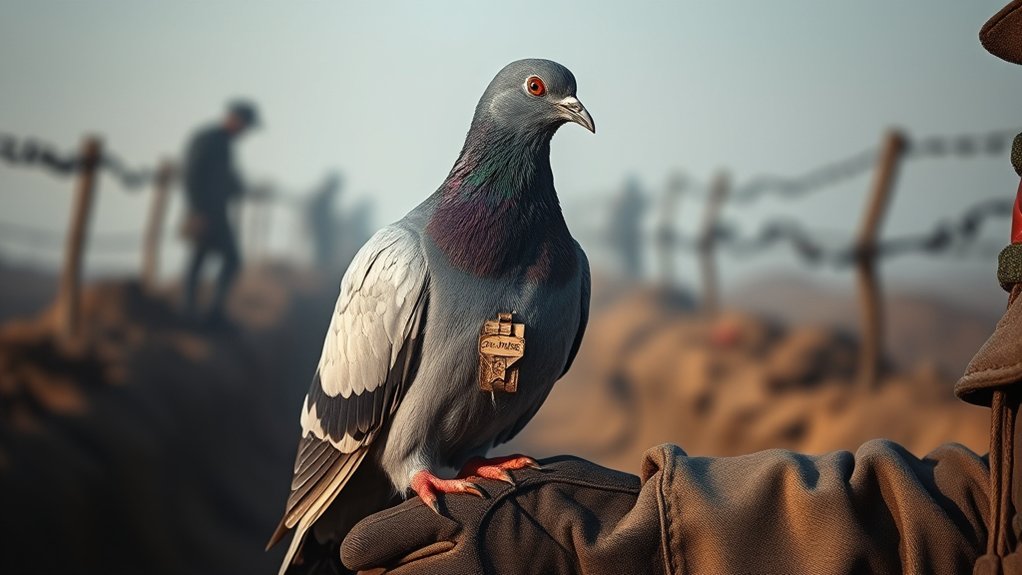
Although radio and telegraph lines often failed or were intercepted during wartime, homing pigeons provided a reliable alternative for transmitting critical messages. During World Wars I and II, the U.S. Army trained over 54,000 pigeons, equipping them to deliver urgent information across enemy lines where other communication means faltered.
You’d often see pigeons navigating through hostile environments, sometimes under fire. Take Cher Ami, for example, who saved nearly 200 soldiers despite severe injuries.
Their ability to maintain communication in disrupted settings proved invaluable, especially during sieges.
The military recognized their contributions by awarding many pigeons medals for bravery, highlighting their vital role in wartime communication networks. This method combined natural instincts with strategic training, making sure messages got through when technology let people down.
What Happened During the Siege of Paris Pigeon Post?
During the Siege of Paris, communication became a huge challenge because the telegraph lines were cut and the city was completely surrounded. So, how did they manage to stay in touch? Well, they came up with a pretty clever solution.
They used pigeons! Balloons would carry these pigeons out of Paris to cities like Tours and Poitiers. Once released, the pigeons would fly back with messages.
This balloon-pigeon relay system made sure that important government and private messages kept getting through, even though the city was isolated. Pretty impressive, right?
Siege Communication Challenges
How did Parisians maintain communication when all conventional lines were severed during the Siege of Paris in 1870–1871? They relied on pigeons as the only dependable method to transmit messages. Despite harsh conditions, pigeons transported over 150,000 official and one million private messages in just four months.
You should note these key challenges:
- Communication lines were completely cut off, forcing reliance on avian couriers.
- Pigeons had to be trained rigorously to navigate back to specific lofts outside the city.
- Messages were often dispatched from balloons or carried across barricades to release points.
- Frequent pigeon losses occurred due to environmental hazards and enemy interference.
This meticulous system showed just how essential pigeons were in keeping crucial communication going when traditional methods failed. It’s pretty impressive how they pulled it off under such tough conditions!
Balloon-Pigeon Message Relay
When conventional communication routes were severed during the Siege of Paris, the combination of balloons and pigeons provided a novel solution to bypass enemy lines. You’d see hot-air balloons carrying trained pigeons from the besieged city, releasing them mid-flight to fly back to their home lofts outside Paris.
This balloon-pigeon relay system allowed thousands of messages, both official dispatches and private communications, to reach the outside world despite the blockade.
By elevating pigeons above ground obstacles and enemy positions, balloons guaranteed uninterrupted message delivery. This innovative method maintained critical contact between Paris and France, showing how aerial transport combined with avian navigation created a reliable communication network under siege conditions.
It’s pretty impressive how this technique overcame physical and military barriers so efficiently.
Where Else Was Pigeon Post Used Around the World?
Although pigeon post is often associated with specific historical events, its use has been widespread across various regions and periods. You’ll find evidence of this communication method in diverse contexts.
Pigeon post, once vital, spanned many eras and places, proving its versatile communication power.
- Ancient Egypt (circa 1350 B.C.E.), where pigeons reported Nile flood levels and military updates.
- Franco-Prussian War (1870–1871), when pigeons carried thousands of messages into besieged Paris, bypassing disrupted telegraph lines.
- India, where police used pigeon posts in emergencies, with the last official service ending in Cuttack in 2008.
- Catalina Island, USA (1894–1898), where pigeons transported mail across the Santa Barbara Channel between Avalon and Los Angeles.
These examples highlight the adaptability of pigeon post in overcoming geographic and technological barriers. It provided reliable communication before modern networks existed. Quite impressive, right?
What Were the Challenges and Limits of Pigeon Post?
While pigeon post proved effective across many regions and eras, it wasn’t without significant challenges that limited its reliability and scope. You have to think about the high mortality rates pigeons faced, especially when flying over tough terrains or dealing with bad weather.
Since pigeons rely on training and specific navigation cues, they can’t just deliver messages spontaneously or without prior conditioning. The accuracy of delivery depends on precise addressing and the birds’ ability to recognize their home lofts.
Environmental factors like changes in lighting, scent interference, or magnetic anomalies can also mess with their navigation.
Plus, pigeons can’t read or interpret messages, so communication is limited to basic message transport rather than complex instructions.
All these factors together put real limits on how effective pigeon post systems could be in practice.
Why Did Pigeon Post Decline and What Replaced It?
As wireless telegraphy and radio communication advanced in the early 20th century, pigeon post rapidly lost its practical value. You see, electronic communication methods offered faster, more reliable message delivery, making pigeons obsolete.
Several key reasons explain this decline: wireless telegraphy and radio allowed instant transmission over vast distances. Telephone and telegraph networks provided direct, high-volume communication. Governments and militaries adopted electronic systems for efficiency and data capacity.
After World War I, radio technology became affordable and widespread, which really accelerated the shift away from pigeon post.
Today, modern courier services like FedEx and digital communication have completely replaced pigeon post for practical use. You can appreciate how technological progress transformed message delivery, rendering the once crucial pigeon post a historical communication method.
How Is Pigeon Post Remembered and Used Today?
With modern communication methods having replaced pigeon post, you might wonder how this historic practice is remembered and valued today. The last official pigeon post service ended in 2008 in Cuttack, India, marking the close of practical use.
Modern communication has replaced pigeon post, with the last official service ending in 2008 in India.
However, pigeons remain ceremonially maintained in some regions, particularly in India. They symbolize resilience and reliable communication during emergencies. You’ll also find pigeons featured in cultural events that honor their essential role in communication and rescue efforts.
Museums and historical studies preserve their legacy, offering detailed insights into their contributions. Though modern technology dominates, pigeons still serve as living reminders of early message delivery systems.
Especially in disaster contexts, their symbolism endures. This dual role, practical and commemorative, keeps pigeon post alive in collective memory. It’s pretty amazing how something so old still holds meaning today.
Frequently Asked Questions
Can Other Bird Species Besides Pigeons Deliver Messages?
You can train crows, ravens, and parrots to deliver messages in controlled settings. But only homing pigeons naturally navigate long distances reliably. This makes them uniquely effective for precise message delivery beyond experimental environments.
How Are Messages Attached to Pigeons Safely?
You attach messages to pigeons by placing them in lightweight, sealed capsules. Then, you securely tie these to their legs with small bands. This guarantees the bird’s comfort and flight efficiency.
It’s all about careful balancing and consistent training. That way, the pigeon can fly without any trouble. It’s pretty amazing how well it works!
What Training Do Pigeons Undergo for Message Delivery?
You train pigeons through gradual distance flights, reinforcing homing instincts with visual, magnetic, and olfactory cues. You reward them consistently, strengthening navigation skills over weeks or months to guarantee reliable, accurate message delivery.
It’s all about patience and repetition. The more they fly and get rewarded, the better they become at finding their way back home every time.
How Long Can Pigeons Fly Without Rest?
You can expect pigeons to fly continuously for up to 14 hours without rest, covering distances near 600 miles. Their strong flight muscles and efficient metabolism enable sustained, fatigue-resistant flights at speeds of 50 to 60 mph.
Pretty impressive, right? These birds are built for endurance and speed, making them excellent long-distance flyers. So next time you see a pigeon gliding effortlessly, remember they’re capable of some serious mileage!
Are There Modern Uses for Pigeons Outside Messaging?
Yes, you’ll find pigeons used in ceremonial releases, competitive racing, and scientific research on navigation and cognition.
Sometimes, they even help with experimental data transmission or smuggling small items. It’s pretty interesting how diverse their modern roles are beyond just messaging.
Conclusion
You might be surprised to learn that homing pigeons can navigate over 1,000 miles with remarkable accuracy. They rely on Earth’s magnetic fields and visual landmarks to find their way back home.
Pigeon post declined with advancements in telecommunication. Still, its role, especially during wartime, was essential for secure and rapid message delivery.
Today, pigeon post is a fascinating example of animal navigation and communication. It reminds you how biology and technology once merged to overcome huge logistical challenges in human history.