
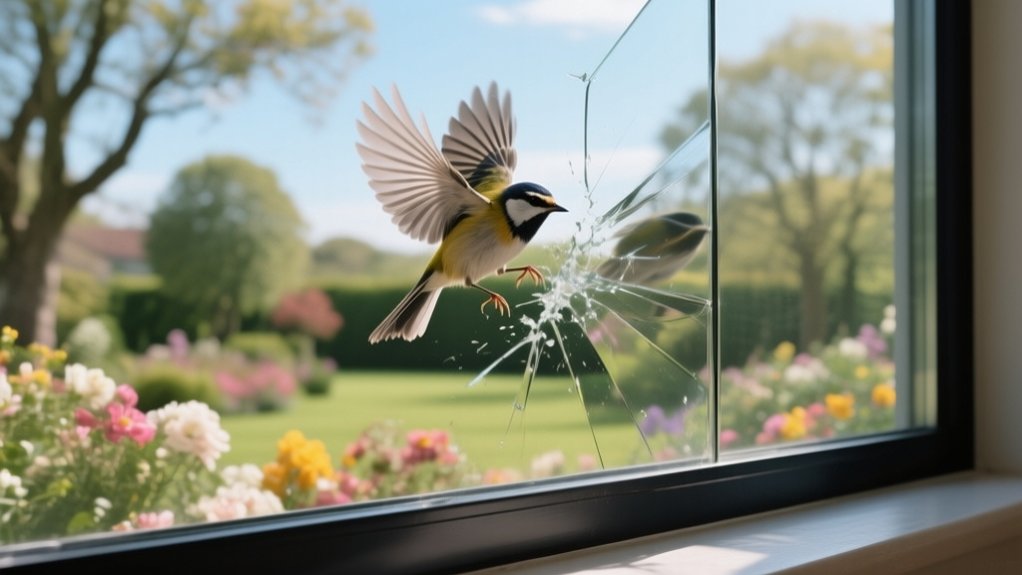
Yes, birds can die from flying into windows because they often can’t recognize glass as a barrier. Collisions cause high-speed impacts, leading to severe physical trauma like concussions, fractures, and internal bleeding. These injuries aren’t always visible but can be fatal.
Even if birds fly away, hidden neurological damage and shock put them at serious risk. You can learn effective prevention methods and how to assist injured birds to improve their chances of survival. It’s important to act quickly and carefully when helping a bird that has hit a window.
How Birds See Windows and Why They Collide
Although windows appear solid and transparent to humans, birds often see them very differently. They mistake reflections of the sky, trees, or habitat for open space or safe passage.
Most birds can’t detect glass as a barrier because it reflects their surroundings instead of appearing transparent.
Birds often fail to see glass as a barrier since it mirrors their environment rather than showing clear transparency.
They rely heavily on visual cues, such as contrast and patterns, which are often insufficient on smooth glass surfaces. Reflections of vegetation or open sky in windows create illusions that lure birds closer. It’s like they’re tricked into thinking it’s a way through.
Also, artificial lighting—including interior lights and light pollution—attracts and disorients birds during low-light conditions. This increases the risk of collisions.
When you understand these perceptual limitations, it makes sense why birds frequently crash into windows. They just can’t reconcile the reflected images with real physical obstacles.
Physical Trauma Birds Suffer From Window Collisions
When birds collide with windows at high speeds, they often sustain severe physical trauma such as concussions, fractures, and internal bleeding. Around 95% suffer concussions, which puts them at risk of neurological damage. Injuries may also include air sac damage, hematomas, and delayed neurological signs that can appear days after the impact.
Many birds go into shock, which affects their ability to fly, forage, and regulate body temperature. This shock raises their risk of mortality. Even if a bird flies away looking fine, internal injuries might still be fatal without quick treatment.
| Injury Type | Frequency (%) | Consequences |
|---|---|---|
| Concussions | 95 | Neurological damage |
| Fractures | Common | Impaired mobility |
| Internal bleeding | Frequent | Organ damage, shock |
| Air sac damage | Notable | Breathing difficulties |
| Hematomas | Occasional | Pain, swelling |
Hidden Risks for Birds That Fly Away
Even if a bird flies away seemingly unharmed after colliding with a window, you should recognize that internal injuries and neurological damage often remain hidden. Birds may suffer from hematomas, concussions, or fractures that aren’t immediately visible but can cause mortality days later.
You need to understand that behavioral changes like disorientation increase vulnerability to predators, starvation, and hypothermia.
Appearance alone doesn’t guarantee survival or health.
Consider these hidden risks for birds that fly away:
- Internal trauma leading to delayed death
- Neurological impairments affecting coordination
- Undetected fractures causing chronic pain
- Increased susceptibility to predation
- Impaired ability to forage or regulate body temperature
Acknowledging these risks helps clarify why flight doesn’t equal safety.
How to Prevent Birds From Flying Into Windows
If you want to stop birds from flying into your windows, it’s important to tackle the problem of window reflections first. One way to do this is by adding visible patterns or putting up impact-absorbing screens. These help birds recognize the glass as a barrier.
Another trick is to use visual deterrents, like UV-reflective decals. Birds can see these decals clearly, but they don’t get in the way of your view. It’s a simple way to keep your windows bird-friendly.
Also, don’t forget about nighttime. Bright lights can attract and confuse nocturnal birds near glass surfaces. So, turning down or reducing outdoor lighting at night can make a big difference.
Window Reflection Solutions
Although birds often fail to recognize glass as a barrier because of reflections and transparency, you can greatly reduce collisions by applying specific window treatments. These solutions change the visual cues birds rely on, making windows easier for them to detect and less hazardous.
Here are some scientifically backed strategies you might want to try:
Apply outside decals or tape that are at least ¼ inch wide and space them no more than 2 inches apart to break up reflections. You can also use UV-reflective decals that birds can see but are nearly invisible to humans.
Installing external impact-absorbing barriers like screens or netting helps both break reflections and cushion impacts.
Another option is to choose fritted, frosted, or acid-etched glass to cut down on transparency and reflection.
It’s also a good idea to update window patterns regularly with bird-friendly designs to keep them effective.
Using these methods systematically can really lower bird-window collisions by improving both visual and physical deterrents.
Effective Visual Deterrents
Building on window reflection solutions, implementing effective visual deterrents offers a practical way to keep birds from hitting glass surfaces. You can apply outside patterns that are at least ¼ inch in diameter and spaced no more than 2 inches apart. This simple step can reduce collisions by up to 80%.
UV-reflective decals are another great option. They stay nearly invisible to humans but alert birds by disrupting reflections. It’s a clever way to keep birds safe without changing how your windows look much.
Installing impact-absorbing screens or netting acts as a physical barrier. These not only cushion impacts but also cut down on reflections.
Plus, translucent tape strips or rope curtains placed 2 to 3 inches from the glass serve as clear visual cues. These signals help birds know to steer clear of the window.
You might also consider commercial products like Feather Friendly dots or Acopian Bird Savers. These offer professional-grade solutions that boost window visibility for birds. They combine durability with effectiveness, making a big difference in minimizing collision risks.
Reducing Nighttime Lighting
When nighttime lighting remains uncontrolled during peak migration periods, it can disorient birds and increase their risk of window collisions. You can reduce this risk by managing artificial light carefully. Turning off or dimming unnecessary lights during migration seasons lessens bird confusion.
Using motion sensors, timers, or shields controls light exposure and helps minimize attraction for nocturnal migrants. Installing window shades or shutters at night blocks light escape, which reduces reflective glass visibility. Applying UV-reflective decals enhances window detectability in low light.
By adopting these measures, you not only protect birds but also conserve energy and improve nighttime environmental quality. Consider these steps:
- Turn off or dim unnecessary outdoor and indoor lighting
- Use motion sensors, timers, or shields to limit light exposure
- Install window shades, blinds, or shutters at night
- Apply UV-reflective decals to windows
- Implement broader light pollution reduction strategies
What to Do If You Find an Injured Bird
If you find an injured bird, try to handle it as little as possible. Place it carefully in a small, covered container like a box or paper bag lined with a towel to keep it warm.
Get the bird to a wildlife rehabilitator or veterinarian as soon as you can for proper assessment. Avoid feeding or giving it water since it might have internal injuries or be in shock.
Taking a clear photo can really help with evaluating the injury. Keep the bird in a quiet, dark, and warm spot where it’s safe from predators.
| Action | Reason |
|---|---|
| Minimal handling | Reduces stress and further injury |
| Prompt transport | Ensures timely professional care |
| No immediate feeding/watering | Prevents complications from shock or injury |
How Rehab Helps Birds Survive Collisions
Although window collisions often cause severe injuries, immediate rehabilitation greatly improves a bird’s chances of survival. When you intervene quickly, you help stabilize the bird, preventing complications such as hypothermia and starvation.
Sending a photo to a licensed rehabilitator guarantees accurate diagnosis and tailored treatment.
Providing a safe, quiet environment reduces stress and helps the bird recover better. Prompt hydration and minimal handling are essential because they avoid making injuries worse.
Key rehabilitation steps include proper stabilization and medical assessment, accurate diagnosis through photo consultation, and giving the bird a quiet, stress-free recovery space.
Administer hydration quickly and limit handling to reduce stress and injury.
These actions together increase the chances that injured birds recover and safely return to the wild. It really makes a difference when you act fast and follow these guidelines.
Additional Tips to Protect Birds From Window Collisions
Because birds often fail to perceive clear glass as a barrier, implementing physical and visual modifications to windows can substantially reduce collision risks.
You can apply UV-reflective decals, which birds detect due to their ultraviolet vision, making windows more visible. Installing exterior screens or netting 2-3 inches from glass creates a cushion that prevents direct impact.
Impact-absorbing films with patterns spaced no more than 2 inches apart disrupt reflections, further minimizing strikes. During migration, covering windows with translucent or patterned curtains also decreases collisions.
Additionally, regularly assess reflective surfaces by removing unnecessary interior lights and adjusting landscaping to avoid confusing reflections that attract birds.
These combined strategies effectively reduce bird-window collisions, safeguarding avian populations while maintaining your building’s functionality. It’s a simple way to protect our feathered friends without compromising on design or comfort.
Frequently Asked Questions
Are Certain Bird Species More Prone to Window Collisions?
Yes, you’ll find smaller species like sparrows and finches, migratory songbirds, and birds with poor depth perception are more prone to window collisions due to their flight behavior, visual limitations, and attraction to reflections or lights.
These birds often fly quickly and erratically, which makes it harder for them to avoid windows. Plus, their eyes sometimes don’t give them a full sense of how far away objects are.
And when they see reflections of trees or sky, or lights shining through windows, they might think it’s open space and fly right into the glass. It’s a tricky problem for these little guys.
Do Bird Strikes on Windows Happen More During Specific Seasons?
You might think bird strikes happen year-round, but they actually peak during spring and fall migration.
During these seasons, there’s a lot more bird movement, which increases the chances of collisions. Light pollution also plays a big role in heightening these incidents.
Can Window Collisions Affect Bird Migration Patterns?
Yes, window collisions can alter migration patterns by causing mortality and injuries. This disruption affects the timing of migration and reduces population size.
It also impacts species that rely on long-distance travel. But don’t worry, you can help by implementing effective collision prevention measures.
Are There Technologies to Detect Bird Strikes in Real-Time?
Though you won’t find a telegraph for bird strikes, you can use prototypes with cameras, motion sensors, or thermal imaging to detect collisions in real-time. These systems are costly and not yet widely available commercially.
But the good news is that technology is evolving. More affordable and effective solutions might be just around the corner. So, keep an eye out for updates in this space!
How Do Urban Environments Influence Bird Collision Rates?
Urban environments increase bird collision rates by featuring numerous reflective glass surfaces and artificial lighting. You’ll notice these elements confuse birds, making windows appear like open sky or habitat. This confusion substantially raises injury and fatality risks.
It’s kind of like when you see a reflection and think it’s real. Birds don’t realize the danger until it’s too late, which is why these collisions happen so often in cities.
Conclusion
You might be surprised to learn that nearly one billion birds die every year in the U.S. just from flying into windows. That’s a huge number! It really shows how important it is to take steps to prevent this.
Birds don’t see glass the way we do. They often mistake reflections or clear windows for open sky or habitat. But the good news is, there are things you can do. Applying decals or using special types of glass can make a big difference.
By making these changes, you help protect birds from serious injury or even death caused by windows that seem invisible to them. Your efforts really count when it comes to saving these creatures.