
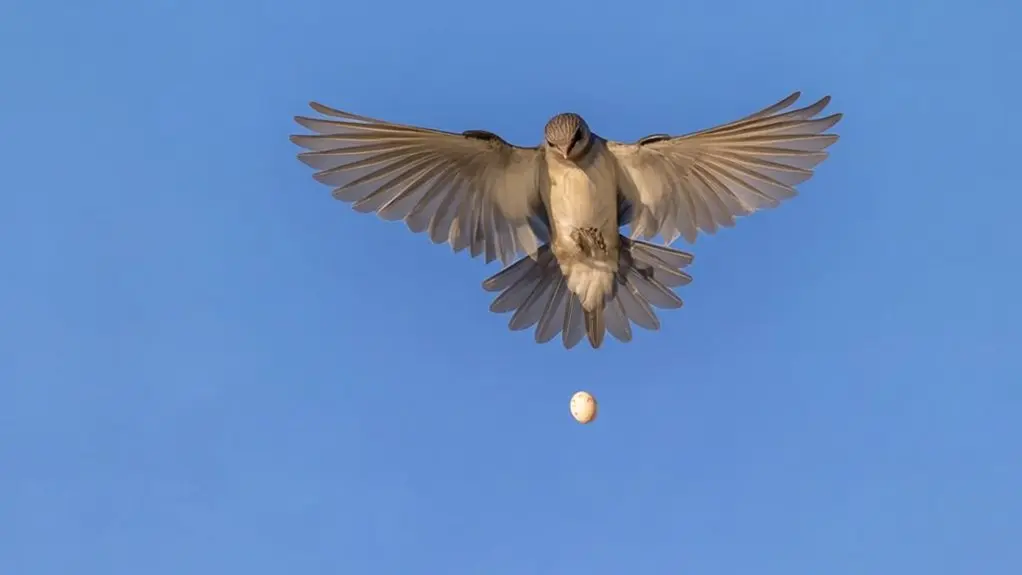
No, birds can’t drop or lay eggs while flying because their anatomy requires them to be stationary. Their rigid pelvic bones, muscles, and complex reproductive tract need stability to safely pass eggs.
Flying adds risk of injury and predation, so evolution favors nesting and incubation on secure grounds. You won’t find any scientific evidence of mid-flight egg laying or accidental drops.
Understanding these biological limits reveals why nesting remains essential for bird reproduction. It’s just how their bodies and behavior have adapted over time.
Can Birds Lay or Drop Eggs While Flying?
How exactly do birds manage the complex process of laying eggs if not while flying? You should know that egg-laying demands a stationary position because of the intricate anatomy involved. Birds’ reproductive tract and cloaca are specifically adapted for depositing eggs in nests, ensuring safety and proper orientation.
Even parasitic species like cuckoos, which lay eggs rapidly near host nests, do so from stable grounds, not mid-air. No scientific data supports birds laying or dropping eggs during flight.
The physiological and physical constraints make airborne egg deposition impossible. This process requires precise muscular control and timing, which can only be executed when the bird is perched or grounded.
That really highlights the necessity of stillness during egg-laying.
Why Birds Don’t Lay Eggs During Flight

Although flight offers birds incredible mobility, their reproductive anatomy and physiology demand stillness to successfully lay eggs. You need to understand that egg-laying requires a stationary environment because the egg must pass through a long, complex internal pathway, which can’t be navigated safely while the bird is in motion.
The cloaca and surrounding skeletal structures physically restrict egg expulsion during flight. Plus, evolution favors incubation and nesting behaviors, ensuring eggs develop in stable, protected conditions. That kind of safety just isn’t possible mid-air.
No evidence shows any bird species laying eggs during flight, which confirms the biological incompatibility between flying and the reproductive process.
How Bird Anatomy Prevents Egg-Laying in Flight
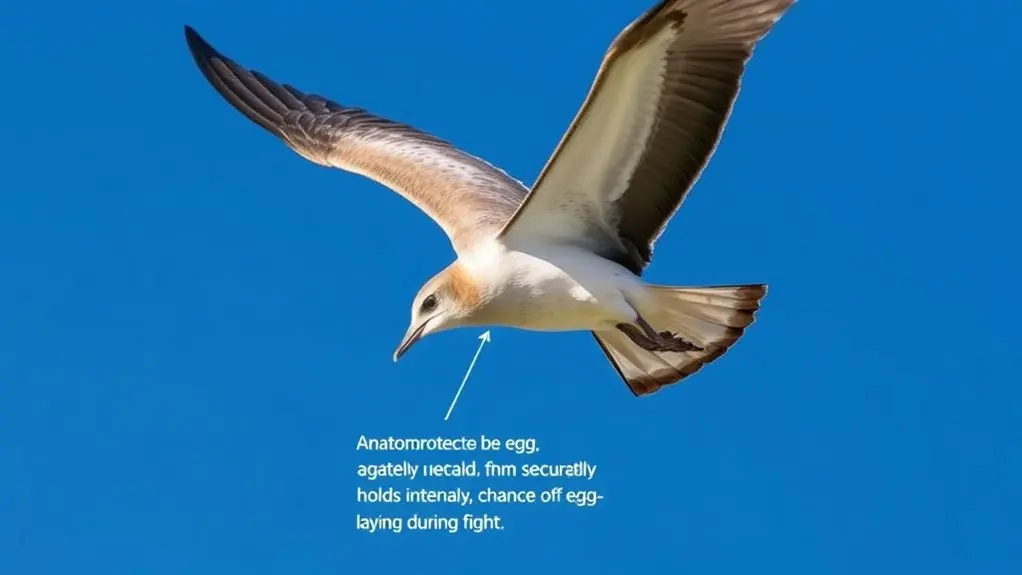
Understanding why birds must be stationary to lay eggs leads directly to examining the specific anatomical features that make in-flight egg-laying impossible. The bones surrounding the cloaca, also called the vent, are rigidly structured to support egg deposition only when the bird is motionless. You’ll find that the reproductive tract inside is long and complex, requiring a stable posture for the egg to pass safely.
During flight, the pelvic bones and associated muscles can’t provide the necessary support or positioning for egg passage. These anatomical adaptations ensure that egg-laying happens exclusively at rest, typically on a nest. This setup prevents any risk of egg loss mid-air.
Can Birds Accidentally Drop Eggs Mid-Flight?
Even if you imagine a scenario where a bird might drop an egg mid-flight, the likelihood remains extremely low due to their reproductive anatomy. Birds’ bodies are designed to hold eggs securely until they’re laid under specific conditions, typically when they’re stationary.
Consider these key points: Egg-laying requires the bird to be still, as the reproductive muscles contract only when the bird is perched or nesting. The egg stays inside the oviduct, physically prevented from release during flight by muscular and anatomical barriers.
Also, there are no documented cases of accidental egg dropping mid-flight in natural environments. This really highlights how biologically improbable it is.
What Happens If a Bird Drops an Egg While Flying?
If a bird drops an egg while flying, the egg will fall quickly because of gravity. Most of the time, it breaks when it hits the ground, which sadly destroys the little embryo inside.
Now, broken eggs don’t just disappear without a trace. They can attract predators and scavengers nearby. This can shake up the local food chain and sometimes put other wildlife at risk.
Plus, cracked eggshells and spilled egg contents don’t just vanish either. They can change the immediate environment by adding nutrients or sometimes even contaminants. So, even a dropped egg can have quite an impact!
Egg Drop Impact
When a bird accidentally drops an egg while flying, the egg almost always breaks upon hitting the ground or another surface due to the force generated by the fall.
The fragile eggshell can’t withstand the sudden impact, leading to cracks or shattering.
You should understand these key factors affecting the egg drop impact:
- Height of the fall: The greater the drop height, the higher the velocity and force upon impact, increasing damage risk.
- Surface type: Hard surfaces cause immediate breakage, while softer grounds like grass may occasionally cushion the fall, though this is rare.
- Eggshell fragility: The thin, brittle shell lacks flexibility, making it highly susceptible to fracture under stress.
Predators and Risks
Beyond the physical damage caused by an egg hitting the ground, dropping an egg while flying exposes it to additional biological risks. You should understand that once an egg falls, it becomes vulnerable to predators such as crows and scavengers. These animals quickly locate and consume it.
This loss directly reduces the bird’s reproductive success. Furthermore, the sudden presence of a dropped egg can attract unwanted attention to the nesting area. That increases predation risks on other eggs or chicks.
You must also consider that this risk encourages birds to incubate and lay eggs in secure nests rather than attempting risky in-flight egg handling. By minimizing egg drops, birds protect their reproductive investment from predation and destruction.
This helps ensure higher survival rates for their offspring.
Environmental Consequences
Several environmental consequences arise from birds dropping eggs while flying, impacting both ecosystems and species survival. When an egg falls and breaks, the effects ripple through the environment in varied ways.
First, there’s the reproductive impact. You’ll see decreased reproductive success for the bird because lost eggs reduce the number of viable offspring. This can threaten the stability of the population over time.
Then, there’s habitat contamination. Broken eggs can change soil composition and nutrient balance, which might disrupt local plants and animals. It’s surprising how much a single egg can affect the environment around it.
Also, predation and pollution come into play. The remains attract predators, which increases risks for nearby nests. Plus, egg debris adds to environmental pollution, creating hazards for small animals and insects.
Understanding these consequences helps us see how a single dropped egg can influence broader ecological dynamics. It really shows how delicate the balance is within natural habitats.
Which Birds Lay Eggs Quickly: and Why?
Although most birds lay eggs while perched or stationary, some species have developed remarkably rapid egg-laying abilities to boost their chances of reproductive success. Cuckoos, for example, can deposit an egg in just a few seconds, usually in a host’s nest. This speed is a vital adaptation to reduce detection by the host species.
By doing this, cuckoos minimize the risk of their eggs being rejected or attacked. These parasitic birds don’t lay eggs during flight; instead, they rely on swift, precise timing while perched. This rapid egg-laying strategy helps cuckoos avoid predators and increase their reproductive success.
Anatomical and physiological constraints prevent birds from laying eggs mid-flight, so even the quick-laying species perform this action only when stationary. Understanding this helps us see the evolutionary pressures shaping avian reproductive behaviors.
It’s pretty fascinating how nature fine-tunes these behaviors for survival.
How Birds Build Nests to Lay Eggs Safely
While birds can’t lay eggs during flight, they take great care in preparing a secure place for this critical stage of reproduction. You’ll notice that birds select sheltered locations such as trees, shrubs, or the ground to safeguard their eggs from predators and harsh weather.
They build nests using materials like twigs, grass, feathers, and mud, which create a stable and insulated environment. The nests are carefully structured to allow easy access for egg laying while minimizing risks.
Here are three key aspects you should know:
- Birds choose nest sites that provide safety and environmental protection.
- They use diverse natural materials to guarantee stability and insulation.
- Nest designs reflect species-specific behavior and habitat needs, optimizing egg security during incubation.
Why Evolution Favors Nesting Over Laying Eggs in Flight
Because eggs require a stable and protected environment to develop properly, evolution has strongly favored nesting behaviors over laying eggs in flight. You should understand that nests provide a controlled microhabitat essential for incubation, shielding eggs from physical trauma, predators, and environmental fluctuations.
The bird’s reproductive anatomy further restricts in-flight egg laying; the egg must pass through a relatively long pathway, making rapid deposition during flight biologically impractical. Additionally, stationary incubation allows birds to regulate temperature and humidity, directly increasing hatch success rates.
Even parasitic birds, like cuckoos, lay eggs quickly but always on nests, highlighting the necessity of a stable platform. If eggs were laid mid-flight, they’d face immediate risks such as impact damage, predation, and exposure, dramatically reducing survival chances.
Evolution therefore favors nesting as a critical reproductive strategy.
Frequently Asked Questions
How Do Birds Protect Eggs From Predators Once Laid?
You protect bird eggs by choosing concealed nests, using camouflage, incubating them in safe locations, and defending aggressively. Some species use environmental heat, like decaying vegetation, ensuring eggs stay hidden and safe from predators.
It’s pretty clever how birds do this. They pick spots that keep their eggs out of sight and stay on guard to keep predators away. Plus, using things like warm compost to incubate eggs is a neat trick that helps keep them safe without much effort.
What Materials Do Birds Use to Build Their Nests?
You might think birds build with gold bricks, but they actually use twigs, grass, feathers, moss, mud, spider silk, and animal fur. These materials are chosen precisely for insulation, stability, and cushioning.
The exact mix varies depending on the species and environment. It’s pretty clever how they pick what works best for them!
How Long Does It Take for Bird Eggs to Hatch?
Bird eggs typically hatch between 10 to 45 days, depending on the species. Smaller birds usually hatch in about 11 to 14 days.
Larger species, like eagles, can take up to 35 to 45 days. This timing is influenced by factors like temperature and how consistently the eggs are incubated. It really varies quite a bit!
Do All Bird Species Build Nests in Trees?
You might think every bird’s a Robin Hood of the trees, but not all species build nests there. Some prefer shrubs, cliffs, or even the ground.
They adapt their nesting habits to survive and thrive in diverse environments. It’s pretty cool how different birds find unique ways to keep their eggs safe.
How Do Temperature and Environment Affect Egg Incubation?
You’ll find that temperature and environment critically influence egg incubation by regulating embryonic development speed, moisture balance, and eggshell integrity.
Conclusion
You won’t see birds dropping eggs mid-flight because their anatomy and instincts make it nearly impossible. Imagine a fragile egg surviving a high-speed aerial drop without shattering! Birds have evolved precise mechanisms to lay eggs safely in nests, not on the wing.
This incredible adaptation guarantees embryo survival. So, while accidental drops mid-flight are virtually nonexistent, understanding these natural safeguards shows how evolution meticulously protects life from the very moment an egg is laid.